DISCOVER ·
Fruit · All notes →Why Do Mangoes Taste Different Around the World?
Variety, ripeness, growing region and eating stage each change what a mango becomes. A sourced guide to why the same fruit tastes so different.
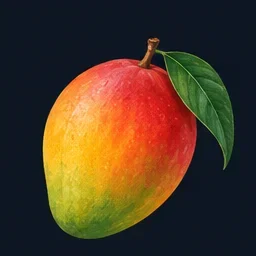
Two mangoes from the same supermarket shelf can taste like different fruits — one honeyed, floral and spoon-soft, the other brisk, faintly resinous and firm enough to cube. Neither one is a failed mango. They differ in almost every way that matters: the variety that grew them, how ripe each one was when it left the tree and when you ate it, the climate and region it grew in, and the eating stage the local cuisine had in mind for it.
The mango family is old and wide. The species is native to southern Asia — eastern India, Myanmar and the Andaman Islands — and it has been cultivated, praised and even revered there since ancient times 1. Everything else in this article is about what happened next.
It starts with the variety
"Mango" is a category, not a single fruit. The horticultural literature describes fruits ranging from nearly round to kidney-shaped, with flesh from pale-yellow to deep-orange, and flavors from very sweet to subacid to tart; some seedling-grown fruits are even fibrous enough to be described as stringy 1.
Named cultivars differ the way apple varieties do. In the classic variety notes, Alphonso is a high-quality mid-season fruit that keeps well in cold storage; Kent is very good to excellent, fiberless and juicy; Tommy Atkins became a commercial shipping staple for durability and disease tolerance, though its flavor is rated only fair to good and suffers when the tree is over-fertilized; Haden was long the Florida standard of excellence before its drawbacks showed 1. A supermarket bin tends to favor the shippers. That is a supply-chain fact before it is a taste fact.
Ripeness is a moving target
A mango is a climacteric fruit: it keeps ripening after it is picked 1. Traditionally, fruit is picked quite green and layered with rice straw to ripen over about a week; commercially, green mangoes are often treated with ethylene, developing full color in 7 to 10 days instead of 10 to 15 — and fruit that needs more than 48 hours of ethylene was picked too early to ever ripen properly 1. Ripening also has a temperature band: it goes best around 70–75°F, and below roughly 55°F the fruit suffers chilling injury 1.
Here is the part that trips everyone up: you cannot read ripeness off the skin. Some varieties stay green when fully ripe — Tong Dum is marketed while still dark-green, and Golek keeps a dull green or yellowish-green skin even when ripe 1. A blush that works for one cultivar tells you nothing about its neighbor. Growers judge readiness by the stem snapping easily with a slight pull, or a purplish-red blush at the base on red-blushed types — cues a shopper can borrow only loosely 1.
Place shapes the fruit
The same cultivar grown in a different climate does not reliably give you the same fruit. Dry weather during flowering is critical: rain or fog at bloom interferes with flowering and encourages fungal disease. Humid-region Indian varieties suffered badly from anthracnose in humid Florida while Philippine and Thai types behaved better there, and Puerto Rico's dry south coast produces fruit without spraying for anthracnose at all 1. Region is not a romantic flourish; it is an input.
This is why several famous mango regions protect their names in law — three of them on two different continents.
- India: Alphonso — known locally as Hapus and described by India's Ministry of Commerce and Industry as the "king of mangoes" — is registered as a Geographical Indication for Ratnagiri, Sindhudurg, Palghar, Thane and Raigad districts of Maharashtra. The same government release notes demand in India and export markets including Japan, Korea and Europe 2.
- Vietnam: Xoài cát Hòa Lộc is covered by geographical-indication registration No. 00016, granted by decision 1737/QĐ-SHTT on 3 September 2009. Vietnam's Intellectual Property Office describes the ripe fruit as bright-yellow, low in fibre, sweet and aromatic 3.
- Mexico: "Mango Ataulfo del Soconusco Chiapas" received a protected denomination of origin in August 2003 for 13 municipalities in Chiapas. The official declaration traces the region's production to research in 1963, when five trees with standout fruit were identified on grower Ataulfo Morales Gordillo's property and used to propagate the mango across Soconusco 4.
Green or ripe is a different dish
The most overlooked reason of all: in much of the mango-growing world, an "unripe" fruit is not a mistake — it is an ingredient.
In Vietnam, green mango is cut into pieces or smashed whole and dipped in freshly pounded chili salt — sour, salty and hot all at once 5. In Mexico, street vendors carve green mango into flowers or cubes, squeeze lime over it, dust it with chili salt and hand it over on a stick 5. Western India goes the other direction entirely: ripe Alphonso pulp is mashed thick with cardamom into aamras — served with fried puris in Maharashtra, or seasoned with dried ginger in Gujarat 6. Same species, opposite eating stages, all of them deliberate.
How to pick one
Nothing here makes any mango "the best one". But the four threads do turn into practical habits:
- Treat skin color as decoration, not a clock — whole families of mangoes stay green when fully ripe 1.
- Let hard fruit finish at room temperature; the ideal band is roughly 70–75°F, and cold below about 55°F damages the ripening process rather than slowing it helpfully 1.
- Buy for the dish, not just the fruit: a firm green mango is the right purchase if chili salt or a cooked preparation is the plan, and a fragrant, yielding one is the right purchase for eating raw 5 6.
See it for yourself
Reading about varieties is the flat version. The fun version is wandering a map where those varieties live. Our Fruit Journey project is built exactly for that: its India stop is themed "A summer of many mangoes" and introduces Alphonso and Kesar by name, while the Vietnam and Mexico stops each meet the same fruit again in a different local voice.
About the facts in this article
- What is sourced: the mango's South Asian origin, the variety differences, ripening behavior and temperature bands, the green-when-ripe cultivars, the climate effects, the three protected-origin stories and the three green/ripe dishes all come from the six numbered references. Each key sentence carries its marker.
- What is editorial: organizing the answer into four threads (variety, ripeness, region, eating stage); reading green mango as a deliberate ingredient rather than a failure; and the observation that three certificates share one instinct. Those framings are ours and are flagged in the notes inside the article.
- What we do not claim: no variety or region "tastes best", no ranking, and nothing in this note is nutrition or health advice.
Sources
- Purdue University NewCROP — Mango (Julia F. Morton, Fruits of Warm Climates) Origin; variety differences in shape, flesh color and flavor; ripening behavior and temperatures; green-when-ripe cultivars; climate and disease effects by region; cultivar notes (Alphonso, Kent, Tommy Atkins, Haden, Tong Dum, Golek).
- Government of India, Press Information Bureau — GI Tag for Alphonso from Konkan (2018) Alphonso GI districts; Hapus and “king of mangoes” wording; named export markets.
- Intellectual Property Office of Vietnam — Hòa Lộc mango geographical indication Registration No. 00016 and decision date; official product description.
- WIPO Lex — Declaration protecting the denomination of origin “Mango Ataulfo del Soconusco Chiapas” 2003 protection, 13 municipalities, the 1963 selection of five trees on Ataulfo Morales Gordillo’s property and regional propagation.
- YaleGlobal Online (archive) — Green Cuisine Green mango with chili salt in Vietnam; mango with chile and lime in Mexico.
- VegRecipes of India — Aamras recipe Aamras preparation with cardamom; puri pairing in Maharashtra and dried-ginger seasoning in Gujarat.