FRUIT JOURNEY
ProjectsCollection 0 / 36Chinese

A LITTLE TRIP FOR YOUR TASTE BUDS

Around the world.
One fruit at a time.

Scroll to meet one fruit at a time.
Open its story to light up your collection.

8 COUNTRIES · 36 FRUITS · ONE JOURNEY

First stop: China ↓
LycheeDragon fruitRambutanAvocado

Lychee, dragon fruit, rambutan… there is more below.

Ready to go

STOP 01 / 08

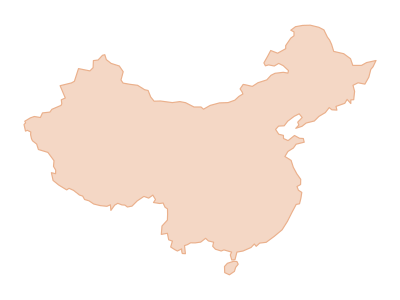
China

From Lingnan to the Qinling Mountains

Familiar fruits. A different hometown for each.

Look closer than the country name. Different regions tell different fruit stories.

8 fruits to discover
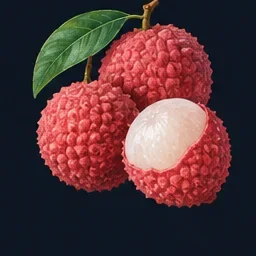
LycheeChina · 01 / 08Lychee Guangdong (Zengcheng, Dongguan and more), Guangxi, Fujian and HainanOne single lychee once sold for 555,000 yuan — a Guinness record.Read the full story
SPECIMEN 21 / 36
Lychee

China · A DISCOVERY AT THIS STOP

Lychee

⌖ Guangdong (Zengcheng, Dongguan and more), Guangxi, Fujian and Hainan

One single lychee once sold for 555,000 yuan — a Guinness record.

In 2002 Zengcheng auctioned ten lychees from the 400-year-old mother Gualv tree for 1.315 million yuan in total — the priciest single fruit at 555,000 yuan entered Guinness; that tree is the last original Gualv mother tree on Earth.

Local specialty

Guangdong (Zengcheng, Dongguan and more), Guangxi, Fujian and Hainan

The 400-year-old Gualv mother tree in Zengcheng's West Garden is the last of its kind — 'one Gualv, one gold coin'; charity auctions of twenty mother-tree fruits in 2001-02 raised 1.865 million yuan, with one lychee at 555,000 setting a Guinness record.

Local varieties

  • Gualv lychee (grafted descendants now commercially grown)

How to eat it

Choosing and ripeness: Bright red shells with flattened bumps mean ripe; browning shells are past peak.

Edible parts: The white translucent aril; shell and glossy brown pit are discarded.

  1. Crack the shell open with a thumbnail at the stem
  2. Peel the shell off whole
  3. Eat the aril and spit the pit

A FRUIT TRAVEL STORY · China

The 555,000-yuan lychee

In 2002 a single lychee fetched 555,000 yuan — the buyer was in the denim business.

Across 2001-02 Zengcheng charity-auctioned 20 Gualv lychees from the West Garden mother tree: 55,0000 yuan topped 2001, and in 2002 ten fruits brought 1.315 million yuan with the priciest at 555,000 — twice breaking the Guinness 'most expensive fruit' record.

That 400-year-old tree is the last original Gualv; market fruit today are its third- and fourth-generation grafts, and when a premium mall listed them at 1,049 yuan per jin in 2022 it still caused a stir — 'one Gualv, one gold coin' indeed.

The taste

Sweet and floral; slippery, juicy flesh

Its native roots

Southern China

References

Growing regions and native origins are different. Illustrations depict fruits, not specific cultivars.

KiwifruitChina · 02 / 08Kiwifruit Meixian county, Baoji, Shaanxi — core of the Qinling foothills' prime zoneNative to China, the kiwifruit got its new name to dodge Cold War marketing.Read the full story
SPECIMEN 33 / 36
Kiwifruit

China · A DISCOVERY AT THIS STOP

Kiwifruit

⌖ Meixian county, Baoji, Shaanxi — core of the Qinling foothills' prime zone

Native to China, the kiwifruit got its new name to dodge Cold War marketing.

In 1904 schoolteacher Isabel Fraser carried kiwifruit seeds from China to New Zealand, where grower Hayward Wright bred the 'Hayward' variety; in June 1959 exporter Jack Turner proposed the name kiwifruit at a meeting — 'Chinese gooseberry' was a hard sell, and the new name honored New Zealand's national bird.

Geographical indication

Meixian county, Baoji, Shaanxi — core of the Qinling foothills' prime zone

Meixian is China's kiwifruit home: 302,000 mu growing 535,000 tonnes — about a fifth of the national and a tenth of the world crop — on a brand valued over 16 billion yuan selling to 26 countries. Green-fleshed Xuxiang and Cuixiang lead over 20 varieties including red Hongyang and gold Huayou.

Local varieties

  • Xuxiang, Cuixiang (green); Hongyang (red); Huayou (gold)

How to eat it

Choosing and ripeness: Ripe when the ends yield to pressure; hard fruit ripens beside an apple.

Edible parts: The green or gold flesh and tiny seeds are eaten; the fuzzy brown skin is usually peeled (thin-skinned varieties can be eaten whole).

  1. Halve crosswise
  2. Scoop the flesh with a spoon
  3. Or peel and slice

Meixian's Xuxiang kiwifruit carries a citrus-strawberry aroma, tart-sweet and refreshing.

A FRUIT TRAVEL STORY · China

A rename born in a meeting room

The name 'kiwifruit' was settled almost offhandedly at an exporters' meeting in June 1959.

In 1904 New Zealand teacher Isabel Fraser carried kiwifruit seeds home from China; grower Hayward Wright bred the 'Hayward' variety that later ruled the world's shelves.

In June 1959 Jack Turner of Turners and Growers proposed 'kiwifruit' at an Auckland meeting — 'Chinese gooseberry' was a hard sell, and the new name honored New Zealand's brown national bird. Back in China, Meixian has since grown it into a 302,000-mu, 535,000-tonne industry.

A name is not a birthplace

A fruit has a native range, places where it is grown today, and commercial names. Meixian is the Chinese growing region on this journey; New Zealand is part of the story behind its international name. A name does not change a plant’s native range.

The taste

Tangy-sweet and juicy, with tiny edible seeds

Its native roots

China

References

Growing regions and native origins are different. Illustrations depict fruits, not specific cultivars.

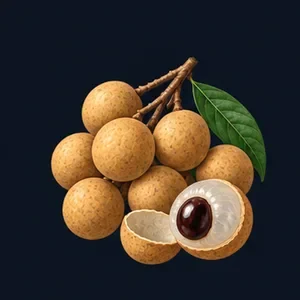
LonganChina · 03 / 08Longan Putian, Fujian — home of 'Xinghua' dried longanFujian gave dried longan a bold nickname: 'longan in the south, ginseng in the north'.Read the full story
SPECIMEN 25 / 36
Longan

China · A DISCOVERY AT THIS STOP

Longan

⌖ Putian, Fujian — home of 'Xinghua' dried longan

Fujian gave dried longan a bold nickname: 'longan in the south, ginseng in the north'.

Putian has grown longan for over 1,600 years — Tang dynasty inscriptions already praise the trees; its dried 'Xinghua' longan ranks first in China and inspired the longan-ginseng saying. The city keeps 80-plus varieties, the most native cultivars in the country.

Geographical indication

Putian, Fujian — home of 'Xinghua' dried longan

Putian has grown longan for over 1,600 years — an 895 AD inscription already praises the trees; Xinghua dried longan ranks first in China ('longan in the south, ginseng in the north') and won national GI protection in 2008, with 80-plus local varieties, the most in the country.

Local varieties

  • Wulongling, Pumen'an, Jiuyuewu, Shuinan No.1 and 80-plus more

How to eat it

Choosing and ripeness: Smooth yellow-brown shells and heavy, plump fruit are best.

Edible parts: The translucent flesh; shell and glossy black seed are discarded. Dried, it becomes 'guiyuan' with the flesh peeled off the pit.

  1. Crack the thin shell with a thumbnail
  2. Pop the flesh in
  3. Spit the seed; dried longan is eaten peeled

A FRUIT TRAVEL STORY · China

Longan in the south, ginseng in the north

Only Putian's dried longan could stand beside ginseng in that old saying.

Putian has grown longan for over 1,600 years — the Tang-era stele of 895 AD already notes 'fine trees branching'; 'Xinghua longan tops the world' pairs with northeastern ginseng in the saying.

Putian keeps 80-plus longan varieties — the most native cultivars in China — with Wulongling, Pumen'an and Jiuyuewu the traditional best; the 1980s-90s 'hundred-li longan belt' was its golden age.

The taste

Sweet, juicy and translucent

Its native roots

Tropical and subtropical Asia

References

Growing regions and native origins are different. Illustrations depict fruits, not specific cultivars.

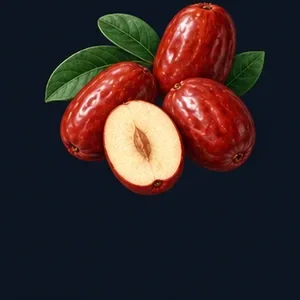
JujubeChina · 04 / 08Jujube Zhanhua district, Binzhou, Shandong — origin at Xiawa townIn 1988 only about 50 of these trees remained nationwide; today it is a 6-billion-yuan industry.Read the full story
SPECIMEN 34 / 36
Jujube

China · A DISCOVERY AT THIS STOP

Jujube

⌖ Zhanhua district, Binzhou, Shandong — origin at Xiawa town

In 1988 only about 50 of these trees remained nationwide; today it is a 6-billion-yuan industry.

A 1984 forestry survey rediscovered the winter jujube in Zhanhua; a 1988 check found the variety unique to the county with barely 50 trees left, most 200-300 years old. Today Zhanhua grows hundreds of thousands of mu, producing 650 million jin worth over 6 billion yuan in 2024, and the name joined the China-EU GI agreement in 2020.

Geographical indication

Zhanhua district, Binzhou, Shandong — origin at Xiawa town

A 1984 forestry survey rediscovered the winter jujube; by 1988 only some 50 trees remained, all in Zhanhua. The 2024 crop hit 650 million jin worth over 6 billion yuan; the name joined the China-EU GI list in 2020, with Binzhou legislating protection in 2025. Xiawa keeps a 300-year-old origin tree still bearing ~150 kg a year.

Local varieties

  • Zhanhua winter jujube (crisp fresh-eating type)

How to eat it

Choosing and ripeness: Red-and-green mottled winter jujubes are crisp and sweet; fully dark ones soften.

Edible parts: Flesh and skin are eaten; spit the small pit.

  1. Rinse and bite in
  2. Chilled crisp fruit tastes best

A FRUIT TRAVEL STORY · China

From 50 trees to 6 billion yuan

In 1988 only about 50 of these trees survived in all of China — all in Zhanhua.

In Zhanhua's 1984 forestry survey technician Li Fuchuan and colleagues rediscovered the winter jujube; a 1988 check confirmed the variety existed only in the county — barely 50 trees, most 200-300 years old.

From courtyards to fields: the 2024 crop reached 650 million jin worth over 6 billion yuan; the name joined the China-EU GI agreement in 2020 and Binzhou legislated for it in 2025. In Xiawa, the 300-year-old origin tree still bears some 150 kg a year.

The taste

Crisp when fresh, more concentrated in sweetness when dried

Its native roots

China and neighboring regions

References

Growing regions and native origins are different. Illustrations depict fruits, not specific cultivars.

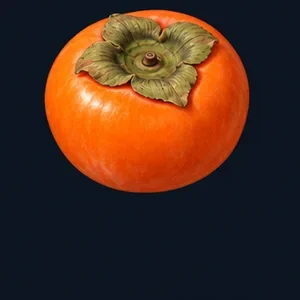
PersimmonChina · 05 / 08Persimmon Fuping county, Weinan, Shaanxi — Caocun town at the coreFuping's dried persimmons once filled imperial New Year boxes — and now earn a county 8.5 billion yuan a year.Read the full story
SPECIMEN 35 / 36
Persimmon

China · A DISCOVERY AT THIS STOP

Persimmon

⌖ Fuping county, Weinan, Shaanxi — Caocun town at the core

Fuping's dried persimmons once filled imperial New Year boxes — and now earn a county 8.5 billion yuan a year.

Fuping has dried persimmons for over 370 years using the local 'jian' persimmon, a Ming-Qing imperial tribute; it is China's largest producer, with a whole-chain value around 8.5 billion yuan, Caocun town at the core.

Geographical indication

Fuping county, Weinan, Shaanxi — Caocun town at the core

Fuping has made hanging-dried persimmons for over 370 years from the local 'jian' cultivar, a Ming-Qing palace tribute; it is China's largest producer with a whole-chain value near 8.5 billion yuan.

Local varieties

  • Fuping jian persimmon (the named drying cultivar)

How to eat it

Choosing and ripeness: Fresh persimmons are eaten only fully soft and de-astringent; the best dried ones wear white frost, soft and molten-hearted.

Edible parts: The softened flesh is eaten; astringent unripe fruit numbs the mouth, and skins and calyxes are discarded.

  1. Let fresh fruit soften, peel and eat the pulp
  2. Dried persimmon is eaten as is, often with tea

How it is eaten here

Fuping hanging-dried persimmon

Peeled persimmons hang and air-dry until frosted — 'white frost, no pit, soft molten heart' — the GI-protected traditional treat and New Year staple.

Paired with: Fuping jian persimmons

An autumn-winter gift and New Year good, once imperial tribute.

A FRUIT TRAVEL STORY · China

370 years of tribute persimmons

Fuping has dried persimmons for 370-plus years — a Ming-Qing palace New Year staple.

Per CNIPA's English materials, Fuping persimmon cakes go back over 370 years, made from the famed local 'jian' cultivar; named Ming-Qing tribute, the GI protection lifted its fame further.

Fuping is now China's largest dried-persimmon base with a whole-chain value near 8.5 billion yuan; Caocun town is the core, where peeled fruit hang-dries under frost — 'white-frosted, pitless, soft and molten-hearted'.

The taste

Sweet when ready; variety and astringency treatment affect texture

Its native roots

East Asia, with a long cultivation history in China

References

Growing regions and native origins are different. Illustrations depict fruits, not specific cultivars.

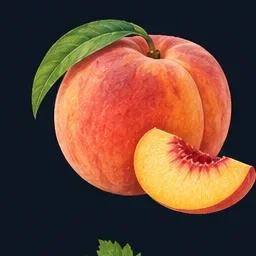
PeachChina · 06 / 08Peach Yangshan town, Huishan district, Wuxi, JiangsuChina's most beloved honey peaches grow on a volcano that died 140 million years ago.Read the full story
SPECIMEN 13 / 36
Peach

China · A DISCOVERY AT THIS STOP

Peach

⌖ Yangshan town, Huishan district, Wuxi, Jiangsu

China's most beloved honey peaches grow on a volcano that died 140 million years ago.

Yangshan is an ancient volcano formed 140 million years ago; its ash-rich soil carries trace elements like zinc and selenium, and with the mild lakeside climate it yields peaches famed for juiciness that 'melt in the mouth' — local records of peach growing date to the Song dynasty.

Geographical indication

Yangshan town, Huishan district, Wuxi, Jiangsu

Yangshan is a 140-million-year-old extinct volcano whose ash soils carry zinc and selenium; peach-growing records run to the Song dynasty, and the 16th-century Wuxi county gazette already notes hillside orchards. The honey peach is a national GI product and Yangshan ranks among China's four famous peach regions.

Local varieties

  • Yangshan honey peach (national GI product)

How to eat it

Choosing and ripeness: Ripe fruit smells sweet and gives slightly; the best honey peaches peel easily.

Edible parts: Flesh and thin skin are eaten; the pit is not.

  1. On a ripe honey peach the skin peels off in strips
  2. Twist it open by hand and free the pit
  3. It drips — hold it over a napkin

A FRUIT TRAVEL STORY · China

Honey peaches on a volcano

Yangshan's peach trees root in 140-million-year-old volcanic ash.

Yangshan is an ancient volcano from tectonic movements 140 million years ago; its acidic ash rock, rich in zinc and selenium, plus the mild lakeside climate, form the 'secret soil' of the honey peach.

Local peach-growing traces to the Song dynasty's Baoqing era, and the Ming Wanli gazetteer notes hillside orchards; today Yangshan ranks among China's four great peach regions, its cultivation system listed as an important agricultural heritage.

The taste

Fragrant and juicy; firm or melting depending on variety

Its native roots

China, with a long history of cultivation

References

Growing regions and native origins are different. Illustrations depict fruits, not specific cultivars.

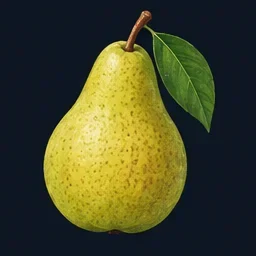
PearChina · 07 / 08Pear Dangshan county, Suzhou city, Anhui province, on the southern Huang-Huai-Hai plainEuropean pears must soften off the tree to be good — the Dangshan su pear is the opposite: it is crispest mature on the tree.Read the full story
SPECIMEN 12 / 36
Pear

China · A DISCOVERY AT THIS STOP

Pear

⌖ Dangshan county, Suzhou city, Anhui province, on the southern Huang-Huai-Hai plain

European pears must soften off the tree to be good — the Dangshan su pear is the opposite: it is crispest mature on the tree.

The Dangshan su pear, a white-pear type, turns crisp and melts in the mouth when tree-ripe — just right on the tree. European pears do the reverse: left to ripen on the tree they fill with gritty stone cells, so they are picked firm and ripened off it. Two pear traditions with opposite rules.

Geographical indication

Dangshan county, Suzhou city, Anhui province, on the southern Huang-Huai-Hai plain

Dangshan su pear is a national GI-protected product: 400,000 mu of pear orchards with over 60,000 century-old trees, producing 910,000 t worth more than 2.86 billion yuan in 2022 — big-fruited, small-cored, crisp and sweet, 'white as jade, melting at the first bite'.

Local varieties

  • Dangshan su pear, a white-pear (Pyrus bretschneideri) type

How to eat it

Choosing and ripeness: Dangshan su pears come in around early-to-mid September; big-fruited, small-cored, thin-skinned and juicy, averaging about 250 g with giants over 1,000 g — crisp enough to crack at a flick.

Edible parts: The flesh eaten with its thin skin; the core is discarded.

  1. Rinse, or peel the thin skin
  2. Cut into wedges and trim the core
  3. Eat fresh for the crisp, juicy bite

If you buy a European pear (e.g. Bartlett), let it soften at room temperature first — the opposite of the su pear.

How it is eaten here

Dangshan pear syrup (qiuli gao)

A thick pear syrup slow-cooked from GI-protected Dangshan pears: the craft was listed in May 2022 among Anhui province's sixth batch of intangible cultural heritage, and the syrup made a 2025 Yangtze-delta gift list.

Paired with: Dangshan pears, rock sugar (some traditional recipes add herbal ingredients)

The pear capital's signature gift and an autumn-winter tradition.

A FRUIT TRAVEL STORY · China

Dangshan: 60,000 century-old pear trees still bear fruit

One county keeps more than 60,000 pear trees over a century old — and still harvested 910,000 tonnes of pears in 2022.

On the southern Huang-Huai-Hai plain, Dangshan keeps 400,000 mu of pear orchards alongside over 60,000 surviving century-old trees — new orchards and ancient ones working side by side. The Dangshan su pear is a national GI-protected product, averaging 250 g with giants past 1,000 g.

In 2022 the county harvested 910,000 t worth over 2.86 billion yuan, on a brand valued at 19.06 billion yuan; the old trees get 'one file per tree' record-keeping, with research institutes stationed locally to improve the stock.

The taste

Asian pears tend to be crisp; ripe European pears often soften

Its native roots

European and Asian pears have different origins across Eurasia

References

Growing regions and native origins are different. Illustrations depict fruits, not specific cultivars.

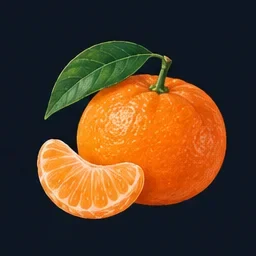
MandarinChina · 08 / 08Mandarin Nanfeng county, Fuzhou city, Jiangxi provinceNanfeng mandarins paid tribute to emperors for over a thousand years — even a master of Tang-Song prose praised them in writing.Read the full story
SPECIMEN 10 / 36
Mandarin

China · A DISCOVERY AT THIS STOP

Mandarin

⌖ Nanfeng county, Fuzhou city, Jiangxi province

Nanfeng mandarins paid tribute to emperors for over a thousand years — even a master of Tang-Song prose praised them in writing.

From the Kaiyuan era of the Tang dynasty, Nanfeng mandarins entered the imperial tribute and kept flowing through Song and Yuan — hence the nickname 'tribute orange'. Zeng Gong, the Tang-Song prose master behind the line 'a hundred bright fruits greet autumn', was a Nanfeng native.

Geographical indication

Nanfeng county, Fuzhou city, Jiangxi province

Nanfeng mandarins have been grown for over 1,300 years and paid imperial tribute from the Tang Kaiyuan era — the 'king of mandarins'; in 2025 the brand was valued at 20.2 billion yuan, ranked 11th among China's GI brands, and leads the country's mandarin exports.

Local varieties

  • Nanfeng tangerine, historically the 'tribute orange'

How to eat it

Choosing and ripeness: Famed for thin skin, few or no seeds and melting juice; ripe when the colour turns full yellow and the fruit feels heavy.

Edible parts: The segments, eaten fresh after peeling; few or no seeds.

  1. Peel the thin skin by hand
  2. Separate the segments
  3. Pop whole segments in your mouth

How it is eaten here

Tangerine cake and candied tangerine

Once locked into fresh-fruit sales, Nanfeng mandarins now turn into jügao cakes, candied jübing, wine and blossom tea, with pectin extracted from the peel — what People's Daily calls the fruit's 'stunning makeover'.

Paired with: Nanfeng mandarins, sugar

A processing push at the origin to fight rock-bottom fresh-fruit prices.

A FRUIT TRAVEL STORY · China

Tribute of three dynasties, homesickness of a prose master

Zeng Gong, who wrote 'a hundred bright fruits greet autumn', came from exactly where these mandarins grow.

Nanfeng mandarins have grown for over 1,300 years; from the Tang Kaiyuan era they entered the imperial tribute and kept flowing through Song and Yuan, earning the name 'tribute orange'. Zeng Gong of the Tang-Song prose masters was a Nanfeng native — his line 'a hundred bright fruits greet autumn' praises these very autumn fruits.

The thousand-year tribute is now a ten-billion-yuan industry: the regional brand was valued at 20.2 billion yuan in 2025, 11th among China's GI brands and first among loose-skinned mandarins, shipping out along the Belt and Road.

The taste

Sweet and aromatic; usually easy to peel

Its native roots

Asia; cultivation histories differ across mandarin types

References

Growing regions and native origins are different. Illustrations depict fruits, not specific cultivars.

KEEP GOINGNext stop: VietnamWhat comes after dragon fruit?↓

STOP 02 / 08

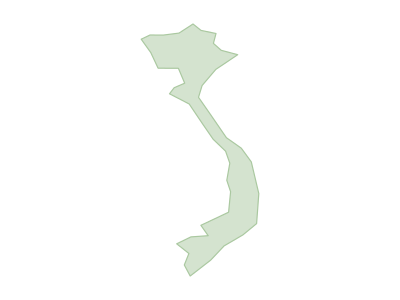
Vietnam

Through tropical street markets

What comes after dragon fruit?

Meet the fruits you recognize at a market but may not yet know by name.

6 fruits to discover
Dragon fruitVietnam · 01 / 06Dragon fruit Bình Thuận province: Phan Thiết city plus Hàm Tân, Hàm Thuận Nam, Hàm Thuận Bắc and Bắc Bình districtsBinh Thuan's dragon fruit farms light up in seas of lamps at night — the lights exist to trick the plants into flowering.Read the full story
SPECIMEN 22 / 36
Dragon fruit

Vietnam · A DISCOVERY AT THIS STOP

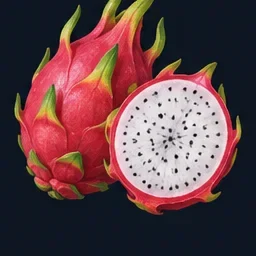
Dragon fruit

⌖ Bình Thuận province: Phan Thiết city plus Hàm Tân, Hàm Thuận Nam, Hàm Thuận Bắc and Bắc Bình districts

Binh Thuan's dragon fruit farms light up in seas of lamps at night — the lights exist to trick the plants into flowering.

Dragon fruit flowering is governed by day length, stopping naturally in the short days of autumn and winter. From the tenth lunar month, growers run lamps all night to induce flowering so fruit lands in the high-price window around Tet; this lets Binh Thuan supply year-round and anchors its off-season exports.

Geographical indication

Bình Thuận province: Phan Thiết city plus Hàm Tân, Hàm Thuận Nam, Hàm Thuận Bắc and Bắc Bình districts

'Binh Thuan Dragon Fruit' became Vietnam's GI in 2006, protected in the EU since 2020 (Japan registration No. 110, 2021); the province's lean, grey, free-draining sandy soil mirrors the fruit's homeland, yielding sweeter, less acidic fruit — commercial since 1990 and exported across continents.

Local varieties

  • White-fleshed varieties (the only type within the GI)

How to eat it

Choosing and ripeness: Ripe when the skin turns bright red and the bracts wilt slightly; Binh Thuan fruit is noted for higher sweetness and lower acidity.

Edible parts: The flesh eaten with its tiny seeds; the skin is not eaten and the bracts are peeled off.

  1. Trim off both ends
  2. Slit the skin lengthwise, just through the rind
  3. Peel the skin off whole and slice the flesh

Binh Thuan grows white-fleshed varieties only; the thick skin and firm bracts suit long-distance shipping.

How it is eaten here

A red note on the Tết five-fruit tray

The southern tray plays name-puns for luck (custard apple, coconut, papaya, mango...); dragon fruit is not one of the traditional five, yet its lucky red skin and showy look have made it a modern centrepiece.

Paired with: Dragon fruit arranged with banana, Buddha's-hand, custard apple, coconut and more

The Tết altar's five-fruit tray, where red means luck; dragon-fruit regions like Binh Thuan and Long An supply it.

A FRUIT TRAVEL STORY · Vietnam

The lamp sea of the tenth lunar month

To make dragon fruit set in winter, Binh Thuan farmers light their orchards like daylight from the tenth lunar month.

One grower in Hàm Liem switched lamps on over 350 of his 1,100 concrete posts at the start of the tenth lunar month, keeping them lit about two months and twenty days; off-season harvest begins in the twelfth lunar month, aimed at the Tet export window.

Growers have also learned to stagger the lamps plot by plot so harvests don't crash the price; Binh Thuan holds growing-area and packing-facility codes for the US, Korea, Australia, New Zealand, China and Japan, and the off-season crop is a solid slice of its exports.

The taste

Mildly sweet and soft, with lightly crunchy seeds

Its native roots

Tropical America; a common name for fruits of several cacti

References

Growing regions and native origins are different. Illustrations depict fruits, not specific cultivars.

LonganVietnam · 02 / 06Longan Sơn La in the north (Sông Mã, Mai Sơn, Yên Châu, Mường La districts) and the Mekong orchard country of Vĩnh Long in the southFujian gave dried longan a bold nickname: 'longan in the south, ginseng in the north'.Read the full story
SPECIMEN 25 / 36
Longan

Vietnam · A DISCOVERY AT THIS STOP

Longan

⌖ Sơn La in the north (Sông Mã, Mai Sơn, Yên Châu, Mường La districts) and the Mekong orchard country of Vĩnh Long in the south

Fujian gave dried longan a bold nickname: 'longan in the south, ginseng in the north'.

Putian has grown longan for over 1,600 years — Tang dynasty inscriptions already praise the trees; its dried 'Xinghua' longan ranks first in China and inspired the longan-ginseng saying. The city keeps 80-plus varieties, the most native cultivars in the country.

Growing region

Sơn La in the north (Sông Mã, Mai Sơn, Yên Châu, Mường La districts) and the Mekong orchard country of Vĩnh Long in the south

Sơn La grew longan on 20,000 hectares in 2023 — a northern mountain mainstay for China-bound export; Vĩnh Long keeps over 60,000 hectares of fruit trees producing past a million tonnes, the Mekong Delta's second fruit province.

How to eat it

Choosing and ripeness: Smooth yellow-brown shells and heavy, plump fruit are best.

Edible parts: The translucent flesh; shell and glossy black seed are discarded. Dried, it becomes 'guiyuan' with the flesh peeled off the pit.

  1. Crack the thin shell with a thumbnail
  2. Pop the flesh in
  3. Spit the seed; dried longan is eaten peeled

A FRUIT TRAVEL STORY · China

Longan in the south, ginseng in the north

Only Putian's dried longan could stand beside ginseng in that old saying.

Putian has grown longan for over 1,600 years — the Tang-era stele of 895 AD already notes 'fine trees branching'; 'Xinghua longan tops the world' pairs with northeastern ginseng in the saying.

Putian keeps 80-plus longan varieties — the most native cultivars in China — with Wulongling, Pumen'an and Jiuyuewu the traditional best; the 1980s-90s 'hundred-li longan belt' was its golden age.

The taste

Sweet, juicy and translucent

Its native roots

Tropical and subtropical Asia

References

Growing regions and native origins are different. Illustrations depict fruits, not specific cultivars.

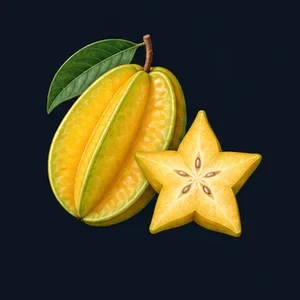
Star fruitVietnam · 03 / 06Star fruit Local food cultureOne fruit, two careers: a sweet export dessert in Malaysia and a souring agent for soup in Vietnamese kitchens.Read the full story
SPECIMEN 31 / 36
Star fruit

Vietnam · A DISCOVERY AT THIS STOP

Star fruit

⌖ Local food culture

One fruit, two careers: a sweet export dessert in Malaysia and a souring agent for soup in Vietnamese kitchens.

Carambola is native to the Malayan archipelago; sweet types (such as Malaysia's B10) are eaten fresh, while the small sour type (khế chua in Vietnamese) is cut into soups for tartness — sweet and sour lines with separate uses.

Local food culture

Local food culture

Local varieties

  • Sour star fruit (khế chua), the small cooking type

How to eat it

Choosing and ripeness: Ripe sweet fruit turns yellow with browned rib edges and feels heavy; the small sour type is tarter the greener it is.

Edible parts: The whole fruit is eaten skin and all (the ribbed edges can be trimmed); seedless or with tiny seeds.

  1. Rinse and trim the ribbed edges
  2. Slice crosswise into star shapes
  3. Serve sweet fruit as is; cook sour fruit in soups

Only crosswise slices give the star profile — lengthwise slices are just fruit pieces.

How it is eaten here

Sour soup with star fruit (canh chua nấu khế)

A rustic Mekong Delta version of canh chua that swaps tamarind for sour star fruit, simmered with snakehead/catfish, tomato, elephant-ear stems and herbs — a bright, fruity tartness.

Paired with: Sour star fruit, snakehead fish, tomato, elephant-ear stems, herbs, fish sauce

A home classic of southern Vietnam; many cooks find the star-fruit sour brighter than tamarind.

A FRUIT TRAVEL STORY · Malaysia

B10: a 'Malaysian star' cloned for two decades

Sixty percent of Malaysia's star fruit trees are one single clone: B10.

Carambola is native to the Malayan archipelago ('belimbing' in Malay); commercial planting started in 1980s Selangor. With 180–250 g fruit that ripens orange-red, sweet and juicy, B10 has been the country's most planted sweet star fruit for over two decades — about 60% of national area, with B11, B17 and others making up the rest.

With such concentration, the way forward is breeding: MARDI (the Malaysian Agricultural Research and Development Institute) has run a hybrid star-fruit program since 1986; in 2017 the country grew star fruit on 828 hectares for both domestic and export markets.

The taste

Crisp and juicy, from sour to sweet

Its native roots

Tropical Asia; its precise wild origin is debated

References

Growing regions and native origins are different. Illustrations depict fruits, not specific cultivars.

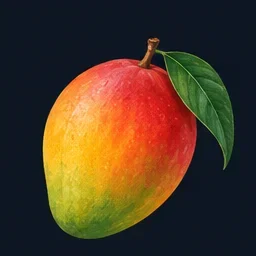
MangoVietnam · 04 / 06Mango Hòa Hưng commune, Cái Bè district, Tiền Giang province — the old Hòa Lộc village, Mekong DeltaSome mangoes sell for several times more not because of taste, but because of a legal certificate of origin.Read the full story
SPECIMEN 01 / 36
Mango

Vietnam · A DISCOVERY AT THIS STOP

Mango

⌖ Hòa Hưng commune, Cái Bè district, Tiền Giang province — the old Hòa Lộc village, Mekong Delta

Some mangoes sell for several times more not because of taste, but because of a legal certificate of origin.

India's Alphonso, Vietnam's Hòa Lộc mango and Mexico's Ataúlfo all carry geographical indication or origin protection: only fruit grown in the defined region under set standards may use the name. The place itself becomes the brand.

Geographical indication

Hòa Hưng commune, Cái Bè district, Tiền Giang province — the old Hòa Lộc village, Mekong Delta

Vietnam GI certificate No. 00016 (decision 1737/QĐ-SHTT, 3 Sep 2009) covering 13 communes of Cái Bè; the mango was first planted in 1930 and made its name winning a 1939–40 agricultural fair.

Local varieties

  • Xoài cát Hòa Lộc, a fragrant mango type

How to eat it

Choosing and ripeness: Ripe when it yields to gentle pressure and the shoulders are full; firm green fruit is sour and best for salads.

Edible parts: The flesh. The pit is large and flat, the skin is not eaten; both green and ripe fruit are used in cooking.

  1. Slice both thick cheeks off along the flat pit
  2. Score the flesh in a crosshatch and push the skin inward to fan out the cubes
  3. Cube ripe fruit to eat fresh; shred green mango to dip in salt or chili salt

Cutting along both sides of the flat pit wastes the least flesh — the pit takes up a wide middle slab.

Green mango is crisp and sour; eaten raw with salt or chili salt, no cooking needed.

How it is eaten here

Green mango with chili salt (muối ớt)

Mango is not only eaten ripe in Vietnam: green fruit is cut or smashed whole and dipped in freshly pounded chili salt — sour, salty and hot at once.

Paired with: Green mango, coarse salt, fresh bird's-eye chilies

A street and backyard snack; one chef recalls climbing mango trees as a child with a jar of chili salt.

A FRUIT TRAVEL STORY · Vietnam

Hòa Lộc: a village's mango calling card

On Vietnam's GI certificate No. 00016, the name is a village: Hòa Lộc.

Hòa Lộc was once a commune of Giáo Đức district in the delta province of Định Tường, merged after 1975 into Hòa Hưng commune, Cái Bè district, Tiền Giang. The first mangoes went in around 1930, and the fruit shot to fame by winning a 1939–40 agricultural fair.

On 3 September 2009 Vietnam's Intellectual Property Office issued decision 1737/QĐ-SHTT, granting the 'Hòa Lộc' GI certificate No. 00016 over 13 communes of Cái Bè, managed by the provincial science and technology department — the village name had become a legal growing region.

A FRUIT TRAVEL STORY · India

The ID card of the king of mangoes

In October 2018, India's commerce ministry ruled that only mangoes from the Konkan coast may call themselves Alphonso.

Known in India as Hapus and celebrated as the 'king of mangoes', Alphonso received its Geographical Indication in October 2018, awarded by the India Patent Office for the Konkan districts of Ratnagiri, Sindhudurg and neighbouring areas, with the announcement issued by the commerce ministry.

The certificate's value is exclusion: fruit from Karnataka and elsewhere can no longer pass as Devgad stock. Alphonso ships to Japan, Korea, the US, Australia and Europe — though buyers should note India's first GI was Darjeeling tea in 2004, and 325 products already held the status when Alphonso joined.

A FRUIT TRAVEL STORY · Mexico

The mango named after a grower

The 'champagne mango' in global supermarkets is really the Ataúlfo — named after a Mexican grower.

The cultivar honours Ataúlfo Morales Gordillo, a Chiapas grower. On 27 August 2003 Mexico's industrial property institute granted the state government the denomination of origin 'Mango Ataúlfo del Soconusco de Chiapas', one of the country's 18 DOs.

Its family history is more dramatic: a Philippine-type mango whose ancestor reached Mexico before 1779 via the Manila–Acapulco galleon trade. Today some 18,000 hectares on the Soconusco coast carry that 500-year-old route forward, while 'champagne' and 'honey' mango are its market stage names.

The taste

Sweet and floral; soft, juicy when ripe

Its native roots

South Asia through Myanmar

References

Growing regions and native origins are different. Illustrations depict fruits, not specific cultivars.

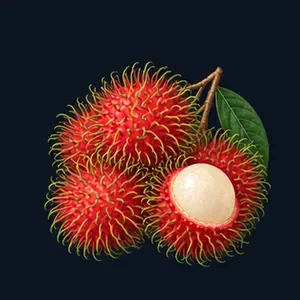
RambutanVietnam · 05 / 06Rambutan Southern growing areas: the Cát Tiên orchard belt of Lâm Đồng, and the Mekong Delta's Vĩnh Kim area of Tiền Giang plus the Bình Hòa Phước commune cooperativeIn Malay, 'rambut' means hair — the name is as blunt as the fruit's appearance.Read the full story
SPECIMEN 26 / 36
Rambutan

Vietnam · A DISCOVERY AT THIS STOP

Rambutan

⌖ Southern growing areas: the Cát Tiên orchard belt of Lâm Đồng, and the Mekong Delta's Vĩnh Kim area of Tiền Giang plus the Bình Hòa Phước commune cooperative

In Malay, 'rambut' means hair — the name is as blunt as the fruit's appearance.

Rambutan is native to Southeast Asia with its centre of diversity in Indonesia; it is a close lychee relative — strip the spiky rind and a translucent sweet flesh waits inside. Thailand grows the most (450,000 t in 2014), Malaysia ranks third.

Growing region

Southern growing areas: the Cát Tiên orchard belt of Lâm Đồng, and the Mekong Delta's Vĩnh Kim area of Tiền Giang plus the Bình Hòa Phước commune cooperative

Cát Tiên has long been a fruit belt of southern Lâm Đồng with commercial rambutan orchards; in the Mekong Delta, the Bình Hòa Phước cooperative exports rambutan to France and the Netherlands under a producers'-group model. Vietnam's rambutan concentrates in the mild southern region.

How to eat it

Choosing and ripeness: Ripe when the rind is bright red and the spines still firm; dull brown means overripe.

Edible parts: The flesh (aril); the hairy rind and the central seed are not eaten.

  1. Snap or cut the rind around the middle
  2. Squeeze the rind to pop the flesh out
  3. Eat the flesh and spit out the seed

Fully ripe rind peels off in one piece — no knife needed.

A FRUIT TRAVEL STORY · Thailand

In 1926, a Chinese-Malay grower planted Thailand's first rambutan

Thailand's rambutan did not begin in a royal orchard but with a Chinese-Malay grower named K. Vong.

In 1926, K. Vong planted rambutan at Ban Na San in Surat Thani — the accepted starting point of Thailand's rambutan. A century on, Surat Thani's fruit is a regional signature, celebrated with an annual fair every August harvest.

Thailand now leads the world (450,000 t in 2014); 'Rong Rien', among its most planted commercial cultivars, keeps appearing in postharvest research, and Malaysia ranks third at 60,000 tonnes.

The taste

Sweet with springy flesh

Its native roots

Southeast Asia

References

Growing regions and native origins are different. Illustrations depict fruits, not specific cultivars.

CoconutVietnam · 06 / 06Coconut Bến Tre province, the river-island land of the Mekong DeltaA coconut can float on the ocean for over a hundred days and colonize tropical coasts by itself, riding the currents.Read the full story
SPECIMEN 05 / 36
Coconut

Vietnam · A DISCOVERY AT THIS STOP

Coconut

⌖ Bến Tre province, the river-island land of the Mekong Delta

A coconut can float on the ocean for over a hundred days and colonize tropical coasts by itself, riding the currents.

A coconut is a drupe: the fibrous mesocarp provides buoyancy and the hard endocarp shields the seed. Studies estimate wild coconuts float about 110 days and drift some 4,800 km; they germinate only after freshwater on shore lifts the salt inhibition.

Growing region

Bến Tre province, the river-island land of the Mekong Delta

In 2011 Bến Tre had 51,000 ha of coconut and produced about 400 million nuts a year, with the country's highest oil content; 70 enterprises, 1,400 workshops and nearly 50,000 workers process it, and coconut goods make up half the province's exports to 80-plus countries.

Local varieties

  • Local types including green, yellow and pineapple-scented coconuts

How to eat it

Choosing and ripeness: Young green coconuts hold lots of water and thin jelly flesh — open them to drink; mature coconuts have less water and thick meat for grating and cooking.

Edible parts: The water and the solid endosperm (meat); the woody shell and fibrous husk are not eaten.

  1. Find the three 'eyes' at the top — one is soft
  2. Pierce the soft eye, insert a straw and drink first
  3. Crack the shell, pry out the meat, then shred or press into coconut milk

One of the three 'eyes' is the germination pore — start there to open the nut with least effort.

How it is eaten here

Bến Tre coconut candy (kẹo dừa)

Small chews cooked down from coconut milk, rice malt and sugar — intensely coconutty, slightly chewy, and among Bến Tre's most famous coconut products.

Paired with: Coconut milk, malt syrup from glutinous rice, sugar

Coconut candy and coconut jelly are the province's signature sweets; workshops in the coconut villages let visitors watch the boiling and pulling.

A FRUIT TRAVEL STORY · Vietnam

Bến Tre: turning one coconut into ten times the price

In Bến Tre, a coconut sells for 11,000 dong by the piece but 100,000 once processed — the province's coconut association chief explains the economy with these two numbers.

Bến Tre in the Mekong Delta is Vietnam's 'coconut homeland': in 2011 it grew 51,000 hectares and harvested about 400 million nuts a year, with the country's highest oil content. Every part finds a use — food, drink, furniture, craftwork, even building material.

The value is added by processing: 70 enterprises, 1,400 workshops and nearly 50,000 workers turn coconuts into 40 product lines, led by coconut candy and coconut jelly; the goods account for half the province's exports across more than 80 countries and territories.
The taste

Lightly sweet water; firm, rich mature flesh

Its native roots

Indo-Pacific tropics; its precise origin remains debated

References

Growing regions and native origins are different. Illustrations depict fruits, not specific cultivars.

KEEP GOINGNext stop: ThailandDurian is not the only headline.↓

STOP 03 / 08

Thailand

Eastern orchards, southern flavors

Durian is not the only headline.

Some fruits deserve to be remembered together with their growing region.

6 fruits to discover
DurianThailand · 01 / 06Durian Chanthaburi as the anchor, with Rayong and Trat in the eastern durian beltHailed as the 'king of fruits' yet banned from hotels, subways and flights — its smell is the entry ticket.Read the full story
SPECIMEN 23 / 36
Durian

Thailand · A DISCOVERY AT THIS STOP

Durian

⌖ Chanthaburi as the anchor, with Rayong and Trat in the eastern durian belt

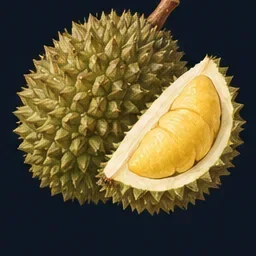
Hailed as the 'king of fruits' yet banned from hotels, subways and flights — its smell is the entry ticket.

Southeast Asia feels both ways: the rich, heady flesh earns the crown, while the pungent odor gets it thrown out of most public places. Thailand's 'Golden Pillow' (Monthong) is big and beginner-friendly; Malaysia's Musang King (D197) sits at the top with bitter-sweet depth.

Growing region

Chanthaburi as the anchor, with Rayong and Trat in the eastern durian belt

The Tourism Authority of Thailand calls Chanthaburi the country's durian capital on fertile soil and balanced rainfall; the three eastern provinces form the core belt, and Thai durian output is projected around 1.76 million tonnes in 2025, dominating the global fresh trade.

Local varieties

  • Monthong ('Golden Pillow', large 3–4 kg fruit with cream flesh), Chanee and others

How to eat it

Choosing and ripeness: Ripe when the stem cut is moist, the fruit rattles faintly when shaken and the spines feel slightly springy; overripe fruit cracks open and smells alcoholic.

Edible parts: The thick pulp (aril) inside each pod; the large seeds are not eaten raw.

  1. Cut along the seams between the rows of spines
  2. Pry the shell apart into halves
  3. Pull out the pods and eat straight

Best eaten as soon as the shell opens; opened durian taints the fridge — seal it well.

How it is eaten here

Durian sticky rice (khao niao turian)

Durian flesh simmered with sweetened coconut cream into a rich sauce over steamed glutinous rice — the durian upgrade of mango sticky rice. The Michelin Guide Thailand has featured restaurant versions, and food writers treat it as a durian-season special.

Paired with: Glutinous rice, coconut cream, sugar, salt, seasonal durian flesh

Seen mostly in the May-June Thai durian season; rare and pricier off-season.

A FRUIT TRAVEL STORY · Thailand

Golden pillows of the durian capital

Thailand's tourism authority gives Chanthaburi an official title: the durian capital.

Over 200 km southeast of Bangkok, Chanthaburi pairs fertile soil with balanced rainfall — the Tourism Authority of Thailand simply calls it 'Thailand's durian capital'; with Rayong and Trat it forms the eastern belt, and the Thai Durian Association is headquartered here.

The flagship is Monthong, the 'Golden Pillow': 3–4 kg fruits with thick cream flesh, the beginner's choice and the star of the annual Chanthaburi fruit festival. Thai output is projected at 1.76 million tonnes in 2025, with the east as the main engine.

A FRUIT TRAVEL STORY · Malaysia

Musang King: a fortune guarded by one GI certificate

On 13 March 2014, the name 'Musang King' became Malaysia's geographical indication no. 00001.

Musang King's official clone code is D197 (alias 'Raja Kunyit'); on 13 March 2014 Malaysia's intellectual-property department registered the name as a geographical indication (GI2014-00001), with Raub and Bentong in Pahang recognised as the premium heartland.

The certificate pays through traceability: Raub's farm-legalisation scheme is, as analysts note, the key to opening China-bound exports — authentic Musang King must be traceable all the way back to Raub hillside orchards.

The taste

Powerful aroma; dense, custard-like flesh

Its native roots

Southeast Asia, especially the Malay Archipelago

References

Growing regions and native origins are different. Illustrations depict fruits, not specific cultivars.

MangosteenThailand · 02 / 06Mangosteen Nakhon Si Thammarat province, southern ThailandLegend says Queen Victoria offered £100 to anyone bringing her a fresh mangosteen — historians find no proof, yet the tale is part of its 'queen of fruits' fame.Read the full story
SPECIMEN 24 / 36
Mangosteen

Thailand · A DISCOVERY AT THIS STOP

Mangosteen

⌖ Nakhon Si Thammarat province, southern Thailand

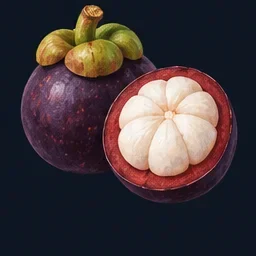
Legend says Queen Victoria offered £100 to anyone bringing her a fresh mangosteen — historians find no proof, yet the tale is part of its 'queen of fruits' fame.

The 'queen' is paired with durian the 'king', and Chinese food therapy even reads mangosteen as 'cooling' — balancing durian's 'heat'. The Queen Victoria reward story traces to fruit explorer David Fairchild's 1930 book and no historical document backs it.

Growing region

Nakhon Si Thammarat province, southern Thailand

Nakhon Si Thammarat anchors Thai mangosteen: researchers built a flowering-date model specifically for the province (season July–November), the province runs an export-quality drive covering 49,000 tonnes, and cooperatives there and in Chumphon signed contracts for 32,000 tonnes. Thailand holds the world's largest planted area, and almost all fresh mangosteen sold in the US is Thai.

Local varieties

  • Commercial purple mangosteen (Garcinia mangostana) lines

How to eat it

Choosing and ripeness: Good fruit is purple-red with a shell that yields slightly to pressure; rock-hard shells usually mean over-mature fruit.

Edible parts: Only the white segments inside are eaten; the thick rind is bitter-tasting and not eaten.

  1. Score the rind around the middle
  2. Break or twist the thick rind open
  3. Lift out the white segments — mind the staining juice

The purple juice that seeps from the rind stains badly — peel over paper.

A FRUIT TRAVEL STORY · Thailand

The queen of fruits and the queen's reward

Queen Victoria offering £100 for a taste of fresh mangosteen? The tale comes from a fruit explorer writing in 1930.

Southeast Asia crowns mangosteen the 'queen of fruits' alongside durian the 'king'; Chinese food therapy even reads it as 'cooling', balancing the durian's 'heat' — a royal couple, one hot, one cool.

The Victoria story traces to fruit explorer David Fairchild's 1930 publication, with no historical document behind it — yet that very lack of proof is dutifully recorded on Wikipedia and has become part of the queen's mythology. Native to the Malay Peninsula and Borneo, mangosteen finds its largest planted area today in Thailand.

The taste

Balanced sweet-tart flavor; delicate white flesh

Its native roots

Southeast Asia; its precise wild origin is not fully resolved

References

Growing regions and native origins are different. Illustrations depict fruits, not specific cultivars.

RambutanThailand · 03 / 06Rambutan Na San district (Ban Na San), Surat Thani provinceIn Malay, 'rambut' means hair — the name is as blunt as the fruit's appearance.Read the full story
SPECIMEN 26 / 36
Rambutan

Thailand · A DISCOVERY AT THIS STOP

Rambutan

⌖ Na San district (Ban Na San), Surat Thani province

In Malay, 'rambut' means hair — the name is as blunt as the fruit's appearance.

Rambutan is native to Southeast Asia with its centre of diversity in Indonesia; it is a close lychee relative — strip the spiky rind and a translucent sweet flesh waits inside. Thailand grows the most (450,000 t in 2014), Malaysia ranks third.

Local specialty

Na San district (Ban Na San), Surat Thani province

In 1926 the Chinese-Malay grower K. Vong planted the first rambutan trees at Ban Na San, Surat Thani — Thailand's starting point for the fruit; an annual rambutan fair runs each August harvest. Thailand is the top producer (450,000 t in 2014).

Local varieties

  • Rong Rien, among Thailand's most planted commercial cultivars

How to eat it

Choosing and ripeness: Ripe when the rind is bright red and the spines still firm; dull brown means overripe.

Edible parts: The flesh (aril); the hairy rind and the central seed are not eaten.

  1. Snap or cut the rind around the middle
  2. Squeeze the rind to pop the flesh out
  3. Eat the flesh and spit out the seed

Fully ripe rind peels off in one piece — no knife needed.

A FRUIT TRAVEL STORY · Thailand

In 1926, a Chinese-Malay grower planted Thailand's first rambutan

Thailand's rambutan did not begin in a royal orchard but with a Chinese-Malay grower named K. Vong.

In 1926, K. Vong planted rambutan at Ban Na San in Surat Thani — the accepted starting point of Thailand's rambutan. A century on, Surat Thani's fruit is a regional signature, celebrated with an annual fair every August harvest.

Thailand now leads the world (450,000 t in 2014); 'Rong Rien', among its most planted commercial cultivars, keeps appearing in postharvest research, and Malaysia ranks third at 60,000 tonnes.

The taste

Sweet with springy flesh

Its native roots

Southeast Asia

References

Growing regions and native origins are different. Illustrations depict fruits, not specific cultivars.

?Somewhere in Southeast Asia, behind several related names…LangsatThailand · 04 / 06Langsat Tanyong Mas village area, Rangae district, Narathiwat provinceThe fruit whose peel glues your fingers with latex — and the Thai trick is to dip it in boiling water first.Read the full story
SPECIMEN 36 / 36
Langsat

Thailand · A DISCOVERY AT THIS STOP

Langsat

⌖ Tanyong Mas village area, Rangae district, Narathiwat province

The fruit whose peel glues your fingers with latex — and the Thai trick is to dip it in boiling water first.

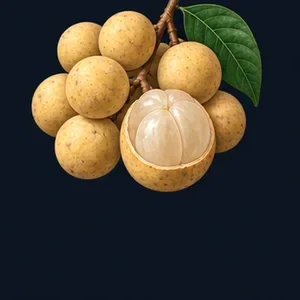
Langsat (Lansium domesticum) originated in western Malaysia; within the species sit the typical langsat (thick-skinned, latex-heavy) and duku (thin-skinned, almost no latex), while Thailand's longkong is a low-latex selection. For the gummy, latex-rich types, a dip in boiling water before peeling removes the stickiness.

Geographical indication

Tanyong Mas village area, Rangae district, Narathiwat province

Longkong Tanyong Mas was registered as a GI with Narathiwat province as applicant (filing 23 Aug 2011 per the DIP gazette PDF; media report the announcement Dec 2016), centred on Tanyong Mas village in Rangae district — reputedly 'the sweetest longkong in Thailand'. The commerce ministry lists it among Narathiwat's four GI products.

Local varieties

  • Longkong, the low-latex selection

How to eat it

Choosing and ripeness: Ripe fruit is yellow-brown with plump clusters; heavy black spotting means the flesh is turning bitter.

Edible parts: The translucent arils; the large seeds are intensely bitter and the peel, rich in tannins and toxic compounds, is never eaten.

  1. For latex-heavy fruit, dip quickly in boiling water first
  2. Tear the thin skin open from the stem end
  3. Eat the translucent segments and spit out the bitter seeds

Longkong, the low-latex selection, needs no hot-water dip — the easiest entry point.

The taste

Translucent segments, sweet with a little tartness

Its native roots

Southeast Asia

References

Growing regions and native origins are different. Illustrations depict fruits, not specific cultivars.

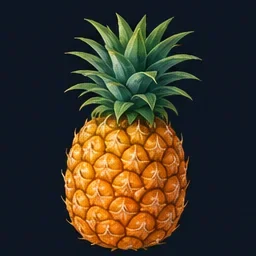
PineappleThailand · 05 / 06Pineapple TratAbout one in every five pineapples eaten in Brazil comes from a single small northeastern state.Read the full story
SPECIMEN 03 / 36
Pineapple

Thailand · A DISCOVERY AT THIS STOP

Pineapple

⌖ Trat

About one in every five pineapples eaten in Brazil comes from a single small northeastern state.

Paraíba harvested 300.9 million fruits in 2024 and returned as Brazil's top pineapple state (about a fifth of the national crop); leadership rotates among Pará, Minas Gerais and Paraíba, with the Campina Grande region the traditional hub.

Meet it here

Trat

How to eat it

Choosing and ripeness: Golden all over with a strong sweet smell at the base means ripe; green-sided fruit is sharper.

Edible parts: The flesh is eaten; the rind, crown and eye spikes are not — the core is kept or trimmed by tenderness.

  1. Slice off the crown and the base
  2. Stand it up and shave the skin off the sides
  3. Cut out the eye spirals at an angle
  4. Quarter lengthwise, core as liked, and cut chunks

A FRUIT TRAVEL STORY · Brazil

Paraíba's rotating throne

Brazil's 'pineapple state number one' crown has changed heads three times in recent years.

The 2022 farm census put Pará first at 1.558 million tonnes; in 2024 Paraíba returned to the top with 300.9 million fruits — about a fifth of Brazil — with Minas Gerais third.

The Campina Grande region is Paraíba's traditional hub — public TV has filmed its pineapple kitchens — while the municipal champion is Pedras de Fogo, third nationwide.

The taste

Bright sweet-tart flavor; juicy and fibrous

Its native roots

South America; southern Brazil–Paraguay is a proposed center

References

Growing regions and native origins are different. Illustrations depict fruits, not specific cultivars.

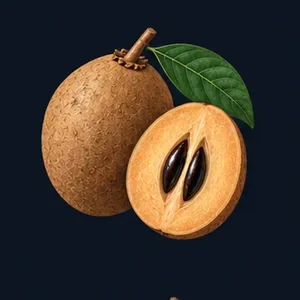
?Another kind of sweetness hides behind brown skin.SapodillaThailand · 06 / 06Sapodilla Ban Mai subdistrict, Phra Nakhon Si Ayutthaya provinceThe tree behind natural chewing gum bears a fruit that tastes like caramel pudding.Read the full story
SPECIMEN 32 / 36
Sapodilla

Thailand · A DISCOVERY AT THIS STOP

Sapodilla

⌖ Ban Mai subdistrict, Phra Nakhon Si Ayutthaya province

The tree behind natural chewing gum bears a fruit that tastes like caramel pudding.

The trunk's latex (chicle) was the original natural chewing-gum base, while the ripe fruit is soft and honey-sweet — called 'lamut' in Thailand and usually likened to caramel, toffee or condensed milk.

Local specialty

Ban Mai subdistrict, Phra Nakhon Si Ayutthaya province

Ban Mai is known for century-old sapodilla orchards, the source of '100-Year Ban Mai Sapodilla Ice Cream', which took first place at a major international ice-cream competition (dubbed the 'food Oscar'); backed by the Ban Mai local administration and promoted via OTOP, it became a local soft-power card.

Local varieties

  • Local century-old sapodilla stock ('lamut')

How to eat it

Choosing and ripeness: Eat only when soft all over; hard fruit is astringent with latex and unpalatable.

Edible parts: The flesh; the skin may stay or go, and the glossy black seeds are not eaten.

  1. Leave at room temperature until fully soft
  2. Halve or break it open
  3. Scoop the flesh with a spoon and spit out the seeds

Trees need 5–8 years before fruiting — which is why century-old orchards are so precious.

How it is eaten here

100-Year Ban Mai Sapodilla Ice Cream

Ice cream made from Ban Mai's century-old-tree sapodillas — caramel-toffee flavoured, and after the award a flagship of Thai OTOP and soft-power promotion.

Paired with: Fully ripe sapodilla flesh, dairy

First place at an international competition and a Silpacheep OTOP exhibit, driven by the Ban Mai subdistrict administration.

A FRUIT TRAVEL STORY · Thailand

Century-old sapodillas, frozen into a 'food Oscar'

From century-old sapodilla orchards in Ayutthaya's Ban Mai came an ice cream that won an international grand prize.

Ban Mai is known for its nearly forgotten century-old sapodilla orchards. Working from the old trees' fruit, local creator Watsarapong Radomsitthipat launched '100-Year Ban Mai Sapodilla Ice Cream' — and it took first place at an international ice-cream competition the press dubbed the 'food Oscar'.

Backed by the Ban Mai subdistrict administration, the product appeared at OTOP showcases as part of Thailand's 'soft power' push — and since sapodilla trees take 5–8 years to fruit at all, those century-old orchards are the town's most precious inheritance.

The taste

Soft and sweet when ripe, with a fine grain

Its native roots

Southern Mexico and Central America

References

Growing regions and native origins are different. Illustrations depict fruits, not specific cultivars.

KEEP GOINGNext stop: MalaysiaWhy learn the variety as well as the fruit?↓

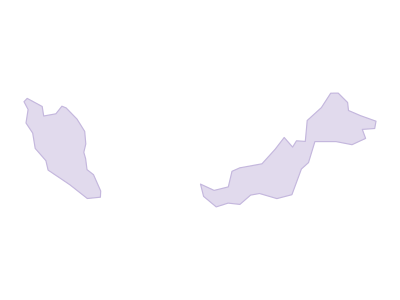
STOP 04 / 08

Malaysia

Many faces of the tropics

Why learn the variety as well as the fruit?

Cross a border and the same fruit can have different local names and varieties.

6 fruits to discover
DurianMalaysia · 01 / 06Durian Raub and Bentong districts, Pahang stateHailed as the 'king of fruits' yet banned from hotels, subways and flights — its smell is the entry ticket.Read the full story
SPECIMEN 23 / 36
Durian

Malaysia · A DISCOVERY AT THIS STOP

Durian

⌖ Raub and Bentong districts, Pahang state

Hailed as the 'king of fruits' yet banned from hotels, subways and flights — its smell is the entry ticket.

Southeast Asia feels both ways: the rich, heady flesh earns the crown, while the pungent odor gets it thrown out of most public places. Thailand's 'Golden Pillow' (Monthong) is big and beginner-friendly; Malaysia's Musang King (D197) sits at the top with bitter-sweet depth.

Geographical indication

Raub and Bentong districts, Pahang state

Musang King (clone D197, also 'Raja Kunyit') was registered as a Malaysian GI on 13 March 2014 (GI2014-00001), with Raub and Bentong recognised as the premium heartland; farm-legalisation schemes in Raub are tied to the traceability China-bound exports demand.

Local varieties

  • Musang King (D197), Black Thorn and others

How to eat it

Choosing and ripeness: Ripe when the stem cut is moist, the fruit rattles faintly when shaken and the spines feel slightly springy; overripe fruit cracks open and smells alcoholic.

Edible parts: The thick pulp (aril) inside each pod; the large seeds are not eaten raw.

  1. Cut along the seams between the rows of spines
  2. Pry the shell apart into halves
  3. Pull out the pods and eat straight

Best eaten as soon as the shell opens; opened durian taints the fridge — seal it well.

A FRUIT TRAVEL STORY · Malaysia

Musang King: a fortune guarded by one GI certificate

On 13 March 2014, the name 'Musang King' became Malaysia's geographical indication no. 00001.

Musang King's official clone code is D197 (alias 'Raja Kunyit'); on 13 March 2014 Malaysia's intellectual-property department registered the name as a geographical indication (GI2014-00001), with Raub and Bentong in Pahang recognised as the premium heartland.

The certificate pays through traceability: Raub's farm-legalisation scheme is, as analysts note, the key to opening China-bound exports — authentic Musang King must be traceable all the way back to Raub hillside orchards.

A FRUIT TRAVEL STORY · Thailand

Golden pillows of the durian capital

Thailand's tourism authority gives Chanthaburi an official title: the durian capital.

Over 200 km southeast of Bangkok, Chanthaburi pairs fertile soil with balanced rainfall — the Tourism Authority of Thailand simply calls it 'Thailand's durian capital'; with Rayong and Trat it forms the eastern belt, and the Thai Durian Association is headquartered here.

The flagship is Monthong, the 'Golden Pillow': 3–4 kg fruits with thick cream flesh, the beginner's choice and the star of the annual Chanthaburi fruit festival. Thai output is projected at 1.76 million tonnes in 2025, with the east as the main engine.

The taste

Powerful aroma; dense, custard-like flesh

Its native roots

Southeast Asia, especially the Malay Archipelago

References

Growing regions and native origins are different. Illustrations depict fruits, not specific cultivars.

RambutanMalaysia · 02 / 06Rambutan The Malay Peninsula (commercial variety belt)In Malay, 'rambut' means hair — the name is as blunt as the fruit's appearance.Read the full story
SPECIMEN 26 / 36
Rambutan

Malaysia · A DISCOVERY AT THIS STOP

Rambutan

⌖ The Malay Peninsula (commercial variety belt)

In Malay, 'rambut' means hair — the name is as blunt as the fruit's appearance.

Rambutan is native to Southeast Asia with its centre of diversity in Indonesia; it is a close lychee relative — strip the spiky rind and a translucent sweet flesh waits inside. Thailand grows the most (450,000 t in 2014), Malaysia ranks third.

Growing region

The Malay Peninsula (commercial variety belt)

In 2014 Malaysia grew 60,000 tonnes — third after Thailand (450,000 t) and Indonesia (100,000 t); peninsula commercial cultivars include Chooi Ang, Peng Thing Bee and Ya Tow.

Local varieties

  • Chooi Ang, Peng Thing Bee, Ya Tow, Azimat, Ayer Mas

How to eat it

Choosing and ripeness: Ripe when the rind is bright red and the spines still firm; dull brown means overripe.

Edible parts: The flesh (aril); the hairy rind and the central seed are not eaten.

  1. Snap or cut the rind around the middle
  2. Squeeze the rind to pop the flesh out
  3. Eat the flesh and spit out the seed

Fully ripe rind peels off in one piece — no knife needed.

How it is eaten here

Rambutan jam with cloves

A Malaysian home preparation: the flesh cooked down with sugar and cloves into a spice-scented jam.

Paired with: Rambutan flesh, sugar, cloves

Listed by the Wikipedia rambutan article as Malaysia's flesh-cooking preparation.

A FRUIT TRAVEL STORY · Thailand

In 1926, a Chinese-Malay grower planted Thailand's first rambutan

Thailand's rambutan did not begin in a royal orchard but with a Chinese-Malay grower named K. Vong.

In 1926, K. Vong planted rambutan at Ban Na San in Surat Thani — the accepted starting point of Thailand's rambutan. A century on, Surat Thani's fruit is a regional signature, celebrated with an annual fair every August harvest.

Thailand now leads the world (450,000 t in 2014); 'Rong Rien', among its most planted commercial cultivars, keeps appearing in postharvest research, and Malaysia ranks third at 60,000 tonnes.

The taste

Sweet with springy flesh

Its native roots

Southeast Asia

References

Growing regions and native origins are different. Illustrations depict fruits, not specific cultivars.

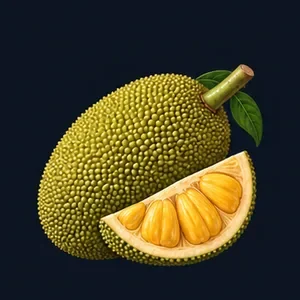
JackfruitMalaysia · 03 / 06Jackfruit The Kota Tinggi and Segamat districts of JohorThe largest tree-borne fruit on Earth — a single one can hit 50 kg, and you oil the knife before cutting.Read the full story
SPECIMEN 27 / 36
Jackfruit

Malaysia · A DISCOVERY AT THIS STOP

Jackfruit

⌖ The Kota Tinggi and Segamat districts of Johor

The largest tree-borne fruit on Earth — a single one can hit 50 kg, and you oil the knife before cutting.

Mature fruit runs 4.5–50 kg; its latex glues hands and knives, so cooks coat them with oil first. Inside are 100–500 pods, each wrapping a seed. Unripe fruit is cooked as a vegetable in curries across South and Southeast Asia, ripe pods are sweet, and the seeds, boiled or roasted, taste like chestnuts.

Growing region

The Kota Tinggi and Segamat districts of Johor

Kota Tinggi (about 192 ha, with Pahang's Temerloh at ~207 ha) anchors national output; per MAFI 2021 (cited in a Pertanika paper), Johor and Pahang are the top supplying states for domestic consumption and exports. Jackfruit ranks 16th of Malaysia's 21 major tropical fruits.

Local varieties

  • Registered clone lines (official Malaysian varieties)

How to eat it

Choosing and ripeness: Ripe when strongly scented, yellow-brown skinned and hollow-sounding when tapped; firm green fruit is the cooking stage.

Edible parts: The pods (yellow arils around each seed) and the seeds; the hard core and thick rind are not eaten.

  1. Coat the knife and your hands with cooking oil
  2. Cut lengthwise into sections and remove the hard core
  3. Pull out the pods, open them and set the seeds aside
  4. Boil or roast the seeds to eat like nuts

Cooking oil clears latex residue better than water.

A FRUIT TRAVEL STORY · Malaysia

Twenty years to knock on China's door

Malaysian jackfruit's China market access took twenty years of negotiation.

After twenty years of negotiation, Malaysian jackfruit (nangka) finally gained China market access, as The Straits Times reported; Johor and Pahang are the top supplying states (MAFI 2021), with Kota Tinggi's roughly 192 hectares a key production zone.

The trade is fragile all the same: jackfruit's chief threat is dieback wilt caused by Erwinia bacteria, and researchers are working specifically on control — the giant tropical fruit's business rests as much on disease management as on the fruit itself.

A FRUIT TRAVEL STORY · India

Panruti: the one town in India growing jackfruit as a monocrop

In April 2025, 'Panruti Palappazham' won its GI — official papers for India's jackfruit capital.

Panruti, in Tamil Nadu's Cuddalore district, is considered the only place in India growing jackfruit as a year-round monocrop: roughly 45,000–50,000 tonnes a year, with hundreds of tonnes traded daily at market in season — and jackfruit is the state fruit of Tamil Nadu.

The GI road was bumpy: a 2016 application was withdrawn in 2020 amid COVID disruptions, refiled in February 2022 (application No. 836), and approved in April 2025 alongside Panruti cashew. Since then the fruit has entered fine dining and plant-based 'mock meat' channels.

One fruit, two roles at the table

The edible bulbs surround seeds, and the whole jackfruit develops from multiple flowers. The University of Florida growing guide describes both cooking immature fruit and eating ripe fruit. Follow the growing entries in India and Malaysia to meet the same fruit in different places.

The taste

Sweet, aromatic bulbs with a firm bite

Its native roots

South Asia, often associated with India’s Western Ghats

References

Growing regions and native origins are different. Illustrations depict fruits, not specific cultivars.

Star fruitMalaysia · 04 / 06Star fruit Selangor (the Serdang, Petaling and Ulu Langat belt) as the core commercial zoneOne fruit, two careers: a sweet export dessert in Malaysia and a souring agent for soup in Vietnamese kitchens.Read the full story
SPECIMEN 31 / 36
Star fruit

Malaysia · A DISCOVERY AT THIS STOP

Star fruit

⌖ Selangor (the Serdang, Petaling and Ulu Langat belt) as the core commercial zone

One fruit, two careers: a sweet export dessert in Malaysia and a souring agent for soup in Vietnamese kitchens.

Carambola is native to the Malayan archipelago; sweet types (such as Malaysia's B10) are eaten fresh, while the small sour type (khế chua in Vietnamese) is cut into soups for tartness — sweet and sour lines with separate uses.

Native roots

Selangor (the Serdang, Petaling and Ulu Langat belt) as the core commercial zone

Carambola is native to the Malayan archipelago (per Singapore's National Library Board); Malaysia's B10 has been the most widely planted sweet star fruit for over two decades (about 60% of plantings), with 828 hectares nationwide in 2017 serving domestic and export markets.

Local varieties

  • B10 (the sweet mainstay, 180–250 g, orange-red when ripe) plus B11 and B17

How to eat it

Choosing and ripeness: Ripe sweet fruit turns yellow with browned rib edges and feels heavy; the small sour type is tarter the greener it is.

Edible parts: The whole fruit is eaten skin and all (the ribbed edges can be trimmed); seedless or with tiny seeds.

  1. Rinse and trim the ribbed edges
  2. Slice crosswise into star shapes
  3. Serve sweet fruit as is; cook sour fruit in soups

Only crosswise slices give the star profile — lengthwise slices are just fruit pieces.

A FRUIT TRAVEL STORY · Malaysia

B10: a 'Malaysian star' cloned for two decades

Sixty percent of Malaysia's star fruit trees are one single clone: B10.

Carambola is native to the Malayan archipelago ('belimbing' in Malay); commercial planting started in 1980s Selangor. With 180–250 g fruit that ripens orange-red, sweet and juicy, B10 has been the country's most planted sweet star fruit for over two decades — about 60% of national area, with B11, B17 and others making up the rest.

With such concentration, the way forward is breeding: MARDI (the Malaysian Agricultural Research and Development Institute) has run a hybrid star-fruit program since 1986; in 2017 the country grew star fruit on 828 hectares for both domestic and export markets.

The taste

Crisp and juicy, from sour to sweet

Its native roots

Tropical Asia; its precise wild origin is debated

References

Growing regions and native origins are different. Illustrations depict fruits, not specific cultivars.

MangosteenMalaysia · 05 / 06Mangosteen The Malay Peninsula and Borneo (native range; the exact original boundaries are now hard to pin down)Legend says Queen Victoria offered £100 to anyone bringing her a fresh mangosteen — historians find no proof, yet the tale is part of its 'queen of fruits' fame.Read the full story
SPECIMEN 24 / 36
Mangosteen

Malaysia · A DISCOVERY AT THIS STOP

Mangosteen

⌖ The Malay Peninsula and Borneo (native range; the exact original boundaries are now hard to pin down)

Legend says Queen Victoria offered £100 to anyone bringing her a fresh mangosteen — historians find no proof, yet the tale is part of its 'queen of fruits' fame.

The 'queen' is paired with durian the 'king', and Chinese food therapy even reads mangosteen as 'cooling' — balancing durian's 'heat'. The Queen Victoria reward story traces to fruit explorer David Fairchild's 1930 book and no historical document backs it.

Native roots

The Malay Peninsula and Borneo (native range; the exact original boundaries are now hard to pin down)

The mangosteen literature (as compiled by Wikipedia) holds the species native to the Malay Peninsula and Borneo, with cultivated stock descending from wild var. malaccensis and var. borneensis; extensive planting has blurred the original native range.

How to eat it

Choosing and ripeness: Good fruit is purple-red with a shell that yields slightly to pressure; rock-hard shells usually mean over-mature fruit.

Edible parts: Only the white segments inside are eaten; the thick rind is bitter-tasting and not eaten.

  1. Score the rind around the middle
  2. Break or twist the thick rind open
  3. Lift out the white segments — mind the staining juice

The purple juice that seeps from the rind stains badly — peel over paper.

A FRUIT TRAVEL STORY · Thailand

The queen of fruits and the queen's reward

Queen Victoria offering £100 for a taste of fresh mangosteen? The tale comes from a fruit explorer writing in 1930.

Southeast Asia crowns mangosteen the 'queen of fruits' alongside durian the 'king'; Chinese food therapy even reads it as 'cooling', balancing the durian's 'heat' — a royal couple, one hot, one cool.

The Victoria story traces to fruit explorer David Fairchild's 1930 publication, with no historical document behind it — yet that very lack of proof is dutifully recorded on Wikipedia and has become part of the queen's mythology. Native to the Malay Peninsula and Borneo, mangosteen finds its largest planted area today in Thailand.

The taste

Balanced sweet-tart flavor; delicate white flesh

Its native roots

Southeast Asia; its precise wild origin is not fully resolved

References

Growing regions and native origins are different. Illustrations depict fruits, not specific cultivars.

?Somewhere in Southeast Asia, behind several related names…LangsatMalaysia · 06 / 06Langsat Western Malay Peninsula (native range)The fruit whose peel glues your fingers with latex — and the Thai trick is to dip it in boiling water first.Read the full story
SPECIMEN 36 / 36
Langsat

Malaysia · A DISCOVERY AT THIS STOP

Langsat

⌖ Western Malay Peninsula (native range)

The fruit whose peel glues your fingers with latex — and the Thai trick is to dip it in boiling water first.

Langsat (Lansium domesticum) originated in western Malaysia; within the species sit the typical langsat (thick-skinned, latex-heavy) and duku (thin-skinned, almost no latex), while Thailand's longkong is a low-latex selection. For the gummy, latex-rich types, a dip in boiling water before peeling removes the stickiness.

Native roots

Western Malay Peninsula (native range)

Purdue's horticultural handbook (Morton, Fruits of Warm Climates) records langsat as originating in western Malaysia, wild and cultivated across the Malay Archipelago, Luzon, southern Thailand, Vietnam and southern India; within the species, duku is the thin-skinned, low-latex form.

Local varieties

  • Typical langsat (latex-heavy) and duku (var. domesticum, thin-skinned, low-latex)

How to eat it

Choosing and ripeness: Ripe fruit is yellow-brown with plump clusters; heavy black spotting means the flesh is turning bitter.

Edible parts: The translucent arils; the large seeds are intensely bitter and the peel, rich in tannins and toxic compounds, is never eaten.

  1. For latex-heavy fruit, dip quickly in boiling water first
  2. Tear the thin skin open from the stem end
  3. Eat the translucent segments and spit out the bitter seeds

Longkong, the low-latex selection, needs no hot-water dip — the easiest entry point.

The taste

Translucent segments, sweet with a little tartness

Its native roots

Southeast Asia

References

Growing regions and native origins are different. Illustrations depict fruits, not specific cultivars.

KEEP GOINGNext stop: IndiaA fruit can play more than one role.↓

STOP 05 / 08

India

A summer of many mangoes

A fruit can play more than one role.

Variety and ripeness can change how you experience these fruits.

7 fruits to discover
MangoIndia · 01 / 07Mango Konkan coast, Maharashtra: Ratnagiri, Sindhudurg and neighbouring areasSome mangoes sell for several times more not because of taste, but because of a legal certificate of origin.Read the full story
SPECIMEN 01 / 36
Mango

India · A DISCOVERY AT THIS STOP

Mango

⌖ Konkan coast, Maharashtra: Ratnagiri, Sindhudurg and neighbouring areas

Some mangoes sell for several times more not because of taste, but because of a legal certificate of origin.

India's Alphonso, Vietnam's Hòa Lộc mango and Mexico's Ataúlfo all carry geographical indication or origin protection: only fruit grown in the defined region under set standards may use the name. The place itself becomes the brand.

Geographical indication

Konkan coast, Maharashtra: Ratnagiri, Sindhudurg and neighbouring areas

In October 2018 Alphonso ('Hapus') won India's GI tag, stopping outsiders from passing off other mangoes as Ratnagiri/Devgad fruit; season runs March–June with exports to Japan, Korea, the US, Australia and Europe.

Local varieties

  • Alphonso, locally 'Hapus', the 'king of mangoes'

How to eat it

Choosing and ripeness: Ripe when it yields to gentle pressure and the shoulders are full; firm green fruit is sour and best for salads.

Edible parts: The flesh. The pit is large and flat, the skin is not eaten; both green and ripe fruit are used in cooking.

  1. Slice both thick cheeks off along the flat pit
  2. Score the flesh in a crosshatch and push the skin inward to fan out the cubes
  3. Cube ripe fruit to eat fresh; shred green mango to dip in salt or chili salt

Cutting along both sides of the flat pit wastes the least flesh — the pit takes up a wide middle slab.

Green mango is crisp and sour; eaten raw with salt or chili salt, no cooking needed.

How it is eaten here

Aamras (mango nectar)

A western-Indian classic: Alphonso pulp mashed thick with cardamom — in Maharashtra served with fried puris, in Gujarat seasoned with dried ginger and ghee.

Paired with: Alphonso mangoes, cardamom; Gujarati style adds saunth (dry ginger) and ghee

A summer mango-season staple, standard in wedding thali meals.

A FRUIT TRAVEL STORY · India

The ID card of the king of mangoes

In October 2018, India's commerce ministry ruled that only mangoes from the Konkan coast may call themselves Alphonso.

Known in India as Hapus and celebrated as the 'king of mangoes', Alphonso received its Geographical Indication in October 2018, awarded by the India Patent Office for the Konkan districts of Ratnagiri, Sindhudurg and neighbouring areas, with the announcement issued by the commerce ministry.

The certificate's value is exclusion: fruit from Karnataka and elsewhere can no longer pass as Devgad stock. Alphonso ships to Japan, Korea, the US, Australia and Europe — though buyers should note India's first GI was Darjeeling tea in 2004, and 325 products already held the status when Alphonso joined.

A FRUIT TRAVEL STORY · Mexico

The mango named after a grower

The 'champagne mango' in global supermarkets is really the Ataúlfo — named after a Mexican grower.

The cultivar honours Ataúlfo Morales Gordillo, a Chiapas grower. On 27 August 2003 Mexico's industrial property institute granted the state government the denomination of origin 'Mango Ataúlfo del Soconusco de Chiapas', one of the country's 18 DOs.

Its family history is more dramatic: a Philippine-type mango whose ancestor reached Mexico before 1779 via the Manila–Acapulco galleon trade. Today some 18,000 hectares on the Soconusco coast carry that 500-year-old route forward, while 'champagne' and 'honey' mango are its market stage names.

A FRUIT TRAVEL STORY · Vietnam

Hòa Lộc: a village's mango calling card

On Vietnam's GI certificate No. 00016, the name is a village: Hòa Lộc.

Hòa Lộc was once a commune of Giáo Đức district in the delta province of Định Tường, merged after 1975 into Hòa Hưng commune, Cái Bè district, Tiền Giang. The first mangoes went in around 1930, and the fruit shot to fame by winning a 1939–40 agricultural fair.

On 3 September 2009 Vietnam's Intellectual Property Office issued decision 1737/QĐ-SHTT, granting the 'Hòa Lộc' GI certificate No. 00016 over 13 communes of Cái Bè, managed by the provincial science and technology department — the village name had become a legal growing region.

The taste

Sweet and floral; soft, juicy when ripe

Its native roots

South Asia through Myanmar

References

Growing regions and native origins are different. Illustrations depict fruits, not specific cultivars.

JackfruitIndia · 02 / 07Jackfruit Panruti, Cuddalore district, Tamil Nadu, and surrounding villagesThe largest tree-borne fruit on Earth — a single one can hit 50 kg, and you oil the knife before cutting.Read the full story
SPECIMEN 27 / 36
Jackfruit

India · A DISCOVERY AT THIS STOP

Jackfruit

⌖ Panruti, Cuddalore district, Tamil Nadu, and surrounding villages

The largest tree-borne fruit on Earth — a single one can hit 50 kg, and you oil the knife before cutting.

Mature fruit runs 4.5–50 kg; its latex glues hands and knives, so cooks coat them with oil first. Inside are 100–500 pods, each wrapping a seed. Unripe fruit is cooked as a vegetable in curries across South and Southeast Asia, ripe pods are sweet, and the seeds, boiled or roasted, taste like chestnuts.

Geographical indication

Panruti, Cuddalore district, Tamil Nadu, and surrounding villages

'Panruti Palappazham' won its Indian GI in April 2025; the town is considered the only place in India growing jackfruit as a year-round monocrop, with about 45,000–50,000 tonnes a year — and jackfruit is Tamil Nadu's state fruit.

Local varieties

  • Local Panruti jackfruit (Palappazham)

How to eat it

Choosing and ripeness: Ripe when strongly scented, yellow-brown skinned and hollow-sounding when tapped; firm green fruit is the cooking stage.

Edible parts: The pods (yellow arils around each seed) and the seeds; the hard core and thick rind are not eaten.

  1. Coat the knife and your hands with cooking oil
  2. Cut lengthwise into sections and remove the hard core
  3. Pull out the pods, open them and set the seeds aside
  4. Boil or roast the seeds to eat like nuts

Cooking oil clears latex residue better than water.

How it is eaten here

Green jackfruit as 'kathal' for the north

Panruti ships masses of green fruit north as 'kathal' — unripe jackfruit vegetable for curries; post-GI it has entered fine dining and plant-based 'mock meat' cooking.

Paired with: Unripe green jackfruit, curry spices, coconut milk (preparations vary)

Unripe jackfruit curry is a pan-South-Asian practice (documented by Wikipedia), with Panruti a major supplier.

A FRUIT TRAVEL STORY · India

Panruti: the one town in India growing jackfruit as a monocrop

In April 2025, 'Panruti Palappazham' won its GI — official papers for India's jackfruit capital.

Panruti, in Tamil Nadu's Cuddalore district, is considered the only place in India growing jackfruit as a year-round monocrop: roughly 45,000–50,000 tonnes a year, with hundreds of tonnes traded daily at market in season — and jackfruit is the state fruit of Tamil Nadu.

The GI road was bumpy: a 2016 application was withdrawn in 2020 amid COVID disruptions, refiled in February 2022 (application No. 836), and approved in April 2025 alongside Panruti cashew. Since then the fruit has entered fine dining and plant-based 'mock meat' channels.

A FRUIT TRAVEL STORY · Malaysia

Twenty years to knock on China's door

Malaysian jackfruit's China market access took twenty years of negotiation.

After twenty years of negotiation, Malaysian jackfruit (nangka) finally gained China market access, as The Straits Times reported; Johor and Pahang are the top supplying states (MAFI 2021), with Kota Tinggi's roughly 192 hectares a key production zone.

The trade is fragile all the same: jackfruit's chief threat is dieback wilt caused by Erwinia bacteria, and researchers are working specifically on control — the giant tropical fruit's business rests as much on disease management as on the fruit itself.

One fruit, two roles at the table

The edible bulbs surround seeds, and the whole jackfruit develops from multiple flowers. The University of Florida growing guide describes both cooking immature fruit and eating ripe fruit. Follow the growing entries in India and Malaysia to meet the same fruit in different places.

The taste

Sweet, aromatic bulbs with a firm bite

Its native roots

South Asia, often associated with India’s Western Ghats

References

Growing regions and native origins are different. Illustrations depict fruits, not specific cultivars.

GuavaIndia · 03 / 07Guava Prayagraj (formerly Allahabad), Uttar Pradesh, in the Ganga–Yamuna doab; the Chail belt of Kaushambi districtGuavas on two continents both carry official origin papers: Calvillo in Mexico and Prayagraj (Allahabad) in India.Read the full story
SPECIMEN 28 / 36
Guava

India · A DISCOVERY AT THIS STOP

Guava

⌖ Prayagraj (formerly Allahabad), Uttar Pradesh, in the Ganga–Yamuna doab; the Chail belt of Kaushambi district

Guavas on two continents both carry official origin papers: Calvillo in Mexico and Prayagraj (Allahabad) in India.

Mexico's Guayaba de Calvillo received IMPI geographical-indication protection published in the federal gazette, while India's pink-fleshed Allahabad Surkha was GI-registered in 2007–08 — both use law to set 'this place's guava' apart from everyone else's.

Geographical indication

Prayagraj (formerly Allahabad), Uttar Pradesh, in the Ganga–Yamuna doab; the Chail belt of Kaushambi district

Pink-fleshed Allahabad Surkha guava was GI-registered in 2007–08 (application No. 50); in 2024 came the first orders from England and Dubai of ten quintals each after a shipment to Oman, with Khusrobagh serving as the local nursery and grower-training hub.

Local varieties

  • Local cultivars: Surkha (red-fleshed), Sebia and Safeda

How to eat it

Choosing and ripeness: Ripe when fragrant and yielding slightly; firm fruit is crisp and tart, good cut into wedges with dips.

Edible parts: The flesh, skin included depending on variety and local habit; the pectin-rich central core is edible too.

  1. Rinse, then halve or wedge
  2. Bite it straight or scoop the core
  3. Cut firm fruit into sticks for salt or chili-salt dips

Guava's high pectin makes it a classic preserving fruit — which is why so many places cook it into pastes and sweets.

How it is eaten here

Amrood chaat (spiced guava)

Street vendors cube partly ripe guava and dust it with chaat masala, salt and chilli, finished with lemon — sour, sweet, salty and hot at once; the Kolkata version adds coriander, ginger, green chilli and mustard paste.

Paired with: Guava, chaat masala, salt, chilli powder, lemon juice

A classic street-cart snack across India — amrood in Hindi, peru in the west.

A FRUIT TRAVEL STORY · India

Allahabad's pink guavas go to sea

In January 2024, England and Dubai placed their first-ever orders for this pink-fleshed guava: ten quintals each.

The Allahabad Surkha guava is known for its red flesh and was GI-registered in 2007–08 (application No. 50). In January 2024 two foreign buyers ordered ten quintals each — Dubai specified Surkha, England took Sebia and Safeda — after an earlier consignment sailed to Oman.

Export pays directly: local prices run 80–100 rupees a kilo against exporters' 120, with freight savings from selling straight off the orchard; at the Khusrobagh nursery hub, growers take courses on canopy management, fruit sizing and disease control.

A FRUIT TRAVEL STORY · Mexico

Calvillo's origin papers and its garlic-chile sprays

To protect the name 'Guayaba de Calvillo', Mexico published a declaration in its federal gazette — and even pest control runs on garlic and chile.

The geographical-indication protection for 'Guayaba de Calvillo' took effect when published in the DOF: the name is now a national asset usable only with IMPI authorization. The local criolla 'Media China' leads the orchards — egg-shaped, cream-fleshed, intensely aromatic and sweet.

Orchards drink from the Calvillo dam; pruning and integrated pest management follow inherited practice, including traditional garlic-and-chile mixtures. About 70% of the harvest stays in Mexico, a fixture of the national fruit stand.

The taste

Fragrant, with white or pink flesh

Its native roots

Tropical America

References

Growing regions and native origins are different. Illustrations depict fruits, not specific cultivars.

?Another kind of sweetness hides behind brown skin.SapodillaIndia · 04 / 07Sapodilla The Dahanu–Gholvad belt, Palghar district, MaharashtraThe tree behind natural chewing gum bears a fruit that tastes like caramel pudding.Read the full story
SPECIMEN 32 / 36
Sapodilla

India · A DISCOVERY AT THIS STOP

Sapodilla

⌖ The Dahanu–Gholvad belt, Palghar district, Maharashtra

The tree behind natural chewing gum bears a fruit that tastes like caramel pudding.

The trunk's latex (chicle) was the original natural chewing-gum base, while the ripe fruit is soft and honey-sweet — called 'lamut' in Thailand and usually likened to caramel, toffee or condensed milk.

Geographical indication

The Dahanu–Gholvad belt, Palghar district, Maharashtra

'Gholvad Sapota (chikoo)' holds an Indian GI held by the Maharashtra Rajya Chikoo Utpadak Sangh; the fruit's sweetness is credited to the coastal climate and soils, and it has been exported to the UK (per a government press release).

Local varieties

  • Gholvad chikoo (the GI-area mainstay)

How to eat it

Choosing and ripeness: Eat only when soft all over; hard fruit is astringent with latex and unpalatable.

Edible parts: The flesh; the skin may stay or go, and the glossy black seeds are not eaten.

  1. Leave at room temperature until fully soft
  2. Halve or break it open
  3. Scoop the flesh with a spoon and spit out the seeds

Trees need 5–8 years before fruiting — which is why century-old orchards are so precious.

How it is eaten here

Chikoo milkshake

The signature drink of the Dahanu-Gholvad highway belt: fully ripe sapodilla blended with milk (often condensed) into a thick shake — a classic reason to stop on the Mumbai-Ahmedabad road.

Paired with: Ripe sapodilla, milk, sugar or condensed milk

A fixture of highway stalls and home breakfasts.

A FRUIT TRAVEL STORY · Thailand

Century-old sapodillas, frozen into a 'food Oscar'

From century-old sapodilla orchards in Ayutthaya's Ban Mai came an ice cream that won an international grand prize.

Ban Mai is known for its nearly forgotten century-old sapodilla orchards. Working from the old trees' fruit, local creator Watsarapong Radomsitthipat launched '100-Year Ban Mai Sapodilla Ice Cream' — and it took first place at an international ice-cream competition the press dubbed the 'food Oscar'.

Backed by the Ban Mai subdistrict administration, the product appeared at OTOP showcases as part of Thailand's 'soft power' push — and since sapodilla trees take 5–8 years to fruit at all, those century-old orchards are the town's most precious inheritance.

The taste

Soft and sweet when ripe, with a fine grain

Its native roots

Southern Mexico and Central America

References

Growing regions and native origins are different. Illustrations depict fruits, not specific cultivars.

BananaIndia · 05 / 07Banana Thrissur district, Kerala: the Chowannur, Puzhakkal, Wadakkanchery, Pazhayannur and Ollukkara blocksAlmost every banana in the supermarket is a clone of one single mother plant — and it has no seeds.Read the full story
SPECIMEN 02 / 36
Banana

India · A DISCOVERY AT THIS STOP

Banana

⌖ Thrissur district, Kerala: the Chowannur, Puzhakkal, Wadakkanchery, Pazhayannur and Ollukkara blocks

Almost every banana in the supermarket is a clone of one single mother plant — and it has no seeds.

The leading cultivar, Cavendish, cannot be sexually propagated — it is cloned from suckers, so fruit worldwide share nearly identical genes. Against a matching pathogen such as Panama disease TR4 there is no population buffer; its predecessor Gros Michel collapsed exactly this way.

Geographical indication

Thrissur district, Kerala: the Chowannur, Puzhakkal, Wadakkanchery, Pazhayannur and Ollukkara blocks

Chengalikodan Nendran banana won central GI registration in August 2015; demand spikes before Onam and the fruit is offered as kazhchakula at Guruvayoor temple.

Local varieties

  • Chengalikodan Nendran, a traditional Thrissur cultivar

How to eat it

Choosing and ripeness: Ripest and sweetest when brown speckles appear on the peel — eat straight from the hand; in Kerala, half-ripe fruit is often steamed whole.

Edible parts: The flesh; the peel is discarded, and commercial varieties have no fully developed seeds.

  1. Pinch the stem end and strip the peel in two flaps
  2. Eat ripe fruit as is — the flesh is seedless
  3. Steam half-ripe fruit in its peel about ten minutes until soft and sweeter

Kerala's habit shows bananas need not be raw only: steamed half-ripe fruit serves as staple or tea snack.

How it is eaten here

Steamed Nendran with grated coconut and honey

Nendran bananas steamed in their peel until soft, then topped with freshly grated coconut and a drizzle of honey — a Kerala home tea-snack and lunchbox treat.

Paired with: Nendran bananas, grated coconut, honey

Typical with breakfast or in tiffin boxes, valued as a lighter alternative to fried snacks.

A FRUIT TRAVEL STORY · India

A banana GI announced outside a bank

In August 2015, outside a cooperative bank in Kerala, the district panchayat president unveiled a GI plaque for a banana.

The Chengalikodan Nendran banana, grown around Chengazhikodu village in Thrissur, received central GI registration. The declaration came at the Peringandur Service Co-operative Bank in Athani, with the district panchayat president unveiling the logo, timed to Onam — the festival when Nendran demand peaks.

It also carries a sacred role: at Guruvayoor temple, whole bunches are offered as kazhchakula. The five blocks of Chowannur, Puzhakkal, Wadakkanchery, Pazhayannur and Ollukkara form its heartland.

A FRUIT TRAVEL STORY · Brazil

The valley brand of Brazil's banana state

In April 2026, bananas from a São Paulo river valley won Brazil's 157th national geographical indication.

The 17 municipalities of Vale do Ribeira grow over 850,000 t of bananas a year, roughly 80% of São Paulo's output — and São Paulo is Brazil's leading banana state (over 960,000 t, Embrapa 2024). 'Banana do Vale do Ribeira' took an INPI Indicação de Procedência covering the Cavendish and Prata groups.

The seal capped a seven-year run: the regional association Abavar applied with Sebrae's support from 2019, pitching a low-carbon, sustainable banana tradition. Brazil now counts 157 national GIs (125 IP plus 32 DO).

The taste

Sweet and fragrant; creamy when ripe

Its native roots

Wild ancestors across South and Southeast Asia

References

Growing regions and native origins are different. Illustrations depict fruits, not specific cultivars.

PapayaIndia · 06 / 07Papaya Leading states rotate: Andhra Pradesh (26-28% of output), Telangana, and Uttar Pradesh (top in area and output for 2023-24)Roughly two of every five papayas in the world grow in India.Read the full story
SPECIMEN 04 / 36
Papaya

India · A DISCOVERY AT THIS STOP

Papaya

⌖ Leading states rotate: Andhra Pradesh (26-28% of output), Telangana, and Uttar Pradesh (top in area and output for 2023-24)

Roughly two of every five papayas in the world grow in India.

India is the world's largest papaya producer (National Horticulture Board: around 3 million tonnes a year, some 38% of the global crop); state leadership shifts year to year — Andhra Pradesh long led with 26-28%, while in 2023-24 Uttar Pradesh ranked first and Telangana second.

Growing region

Leading states rotate: Andhra Pradesh (26-28% of output), Telangana, and Uttar Pradesh (top in area and output for 2023-24)

India is the world's largest papaya producer (National Horticulture Board: about 3 million tonnes a year, ~38% of the global crop); Andhra Pradesh long led, the 2023-24 season put Uttar Pradesh first and Telangana second (ANGRAU outlook), while Andhra still grew 1.26 million tonnes in 2024-25.

How to eat it

Choosing and ripeness: Ripe when the skin is mostly yellow and the flesh gives slightly; green fruit is mostly cooked in Southeast Asia.

Edible parts: The orange flesh is eaten; the peppery black seeds are usually scraped out, and the thick skin is not eaten.

  1. Halve lengthwise
  2. Scoop out the black seeds
  3. Peel and cube, or scoop straight with a spoon

A FRUIT TRAVEL STORY · India

India's papaya dynasty

The world's papayas watch India — and India's leader changes year to year.

India is the world's top papaya grower: the National Horticulture Board records an annual output around 3 million tonnes, some 38% of the global total.

State leadership churns: trade media once credited Andhra Pradesh with 26-28%; ANGRAU's 2023-24 outlook put Uttar Pradesh first in area and output with Telangana second; Andhra still grew 1.26 million tonnes in 2024-25.

The taste

Ripe: sweet and soft. Green: crisp and mild.

Its native roots

Tropical America, probably southern Mexico and Central America

References

Growing regions and native origins are different. Illustrations depict fruits, not specific cultivars.

Sweet orangeIndia · 07 / 07Sweet orange The Vidarbha region of Maharashtra, centred on NagpurThe sweet orange is not a 'pure' species — it is a natural hybrid of mandarin and pomelo.Read the full story
SPECIMEN 07 / 36
Sweet orange

India · A DISCOVERY AT THIS STOP

Sweet orange

⌖ The Vidarbha region of Maharashtra, centred on Nagpur

The sweet orange is not a 'pure' species — it is a natural hybrid of mandarin and pomelo.

Genome sequencing puts roughly 55% of the sweet orange's ancestry in the mandarin and 44% in the pomelo — and both parents were themselves admixed. It is a fixed hybrid lineage built over generations, not a species that arose independently.

Geographical indication

The Vidarbha region of Maharashtra, centred on Nagpur

The Nagpur orange won its GI in 2014 on the argument that its flavour arises only in Vidarbha's specific soils and climate; certification tests size, colour, seed count and juice chemistry, guarding against lookalikes like kinnow — hence Nagpur's nickname, the Orange City.

Local varieties

  • Nagpur orange, a loose-skinned mandarin type

How to eat it

Choosing and ripeness: Ripe when heavy for its size and evenly orange; the Nagpur orange is known for thin, easy-peel skin and juicy pulp — its GI certification itself tests size, colour, seed count and juice quality.

Edible parts: The juice vesicles inside the segments; the rind and white pith are usually peeled off and not eaten.

  1. Ring-cut the peel at the top, or peel by hand
  2. Split into segments and strip the white pith
  3. Eat fresh or halve and squeeze for juice

A FRUIT TRAVEL STORY · India

The Orange City's anti-counterfeit fight

Once the Nagpur orange had its GI, kinnow mandarins could no longer be sold under its name.

In 2014 the Nagpur orange was registered as an Indian GI. The case was blunt: its sweet-sour character emerges 'only under the specific soil and agro-climatic conditions of Vidarbha', certified item by item against size, colour, seed count and juice chemistry.

The government-backed growers' body MahaOrange began registering the first thousand farmers (1,500 rupees each, valid ten years); the expectation is price premiums — and a lockout for lookalike mandarins such as kinnow and Coorg orange.

The taste

Sweet-tart with juicy segments

Its native roots

Southern Asia; exact domestication site uncertain

References

Growing regions and native origins are different. Illustrations depict fruits, not specific cultivars.

KEEP GOINGNext stop: BrazilSome familiar fruits have American roots.↓

STOP 06 / 08

Brazil

The other side of the tropics

Some familiar fruits have American roots.

Connect familiar fruits with their long journeys around the world.

5 fruits to discover
PineappleBrazil · 01 / 05Pineapple Paraíba state, with Campina Grande as the traditional hubAbout one in every five pineapples eaten in Brazil comes from a single small northeastern state.Read the full story
SPECIMEN 03 / 36
Pineapple

Brazil · A DISCOVERY AT THIS STOP

Pineapple

⌖ Paraíba state, with Campina Grande as the traditional hub

About one in every five pineapples eaten in Brazil comes from a single small northeastern state.

Paraíba harvested 300.9 million fruits in 2024 and returned as Brazil's top pineapple state (about a fifth of the national crop); leadership rotates among Pará, Minas Gerais and Paraíba, with the Campina Grande region the traditional hub.

Growing region

Paraíba state, with Campina Grande as the traditional hub

Paraíba picked 300.9 million fruits in 2024 — about a fifth of Brazil — and returned to number one; in recent years the crown has rotated among Pará (first in the 2022 Census), Minas Gerais and Paraíba.

How to eat it

Choosing and ripeness: Golden all over with a strong sweet smell at the base means ripe; green-sided fruit is sharper.

Edible parts: The flesh is eaten; the rind, crown and eye spikes are not — the core is kept or trimmed by tenderness.

  1. Slice off the crown and the base
  2. Stand it up and shave the skin off the sides
  3. Cut out the eye spirals at an angle
  4. Quarter lengthwise, core as liked, and cut chunks

A FRUIT TRAVEL STORY · Brazil

Paraíba's rotating throne

Brazil's 'pineapple state number one' crown has changed heads three times in recent years.

The 2022 farm census put Pará first at 1.558 million tonnes; in 2024 Paraíba returned to the top with 300.9 million fruits — about a fifth of Brazil — with Minas Gerais third.

The Campina Grande region is Paraíba's traditional hub — public TV has filmed its pineapple kitchens — while the municipal champion is Pedras de Fogo, third nationwide.

The taste

Bright sweet-tart flavor; juicy and fibrous

Its native roots

South America; southern Brazil–Paraguay is a proposed center

References

Growing regions and native origins are different. Illustrations depict fruits, not specific cultivars.

Passion fruitBrazil · 02 / 05Passion fruit Bahia state, concentrated around Dom Basílio, Livramento de Nossa Senhora and Rio RealThe English name has nothing to do with a hundred aromas: 'passion' here means the Passion of Christ.Read the full story
SPECIMEN 06 / 36
Passion fruit

Brazil · A DISCOVERY AT THIS STOP

Passion fruit

⌖ Bahia state, concentrated around Dom Basílio, Livramento de Nossa Senhora and Rio Real

The English name has nothing to do with a hundred aromas: 'passion' here means the Passion of Christ.

In the 15th–16th centuries Catholic priests in Latin America read the flower's parts as symbols of the Passion; the genus name Passiflora ('passion flower') comes from that teaching, and passion fruit inherited the same religious sense.

Growing region

Bahia state, concentrated around Dom Basílio, Livramento de Nossa Senhora and Rio Real

Bahia is Brazil's top passion-fruit state: about 321,000 t, 41% of the national total (2012, Embrapa), with some 57% from just three municipalities; the purple passionfruit is native from southern Brazil through Paraguay to northern Argentina — Brazil is both homeland and leading producer.

Local varieties

  • The purple form (aromatic, juicy) and the yellow form (larger, disease-resistant)

How to eat it

Choosing and ripeness: A ripe fruit feels heavy; as the skin goes from smooth to wrinkled the sweet-sour balance peaks. The purple form is native from southern Brazil through Paraguay to northern Argentina.

Edible parts: The juicy pulp arils around the seeds, eaten together with the seeds; the thick hard rind is not eaten.

  1. Cut the thick-skinned fruit in half
  2. Scoop out the seedy pulp with a spoon and eat it as is
  3. Or strain for juice to mix drinks and desserts

The rind is thick and hard — brace it before cutting. The pulp is intensely tart and aromatic; a little flavors a whole bowl.

How it is eaten here

Passion fruit mousse (mousse de maracujá)

Brazil's beloved home dessert: passion fruit juice whipped with condensed milk and cream into a cloud-light mousse — the everyday version blends up in minutes.

Paired with: Passion fruit pulp, condensed milk, cream (older versions add egg whites)

Shared by Brazil and Madeira; referenced dates place its creation around 1962.

A FRUIT TRAVEL STORY · Brazil

A flower read as the Passion

Passion fruit is not about romance: its name invokes a crown of thorns, five wounds and nails.

Catholic priests teaching in 15th–16th century Latin America used this South American flower as a visual aid: the corona as the crown of thorns, the five stamens as the five wounds, the three stigmas as the nails. The genus name Passiflora means 'passion flower', and English 'passion fruit' followed.

The plant itself is genuinely South American: the purple form is native from southern Brazil through Paraguay to northern Argentina. Brazilians call it maracujá — they grow it and eat it everywhere, from fresh market fruit to the national passion fruit mousse.

The taste

Intensely tart and aromatic; juicy pulp with crunchy seeds

Its native roots

Purple passion fruit: southern Brazil to Paraguay and northern Argentina

References

Growing regions and native origins are different. Illustrations depict fruits, not specific cultivars.

PapayaBrazil · 03 / 05Papaya Bahia (about 45% of national output, including the São Francisco valley) and Espírito Santo (around Linhares)Roughly two of every five papayas in the world grow in India.Read the full story
SPECIMEN 04 / 36
Papaya

Brazil · A DISCOVERY AT THIS STOP

Papaya

⌖ Bahia (about 45% of national output, including the São Francisco valley) and Espírito Santo (around Linhares)

Roughly two of every five papayas in the world grow in India.

India is the world's largest papaya producer (National Horticulture Board: around 3 million tonnes a year, some 38% of the global crop); state leadership shifts year to year — Andhra Pradesh long led with 26-28%, while in 2023-24 Uttar Pradesh ranked first and Telangana second.

Growing region

Bahia (about 45% of national output, including the São Francisco valley) and Espírito Santo (around Linhares)

Bahia is Brazil's top papaya state (~45%) and second-largest exporter; Espírito Santo, historically the leading grower-shipper, saw Linhares-based Caliman pioneer the Hawaiian papaya and turn Brazil into an export power. 'Havaí 12-18' and Formosa lead the market.

Local varieties

  • 'Havaí 12-18' (Hawaiian type) and Formosa

How to eat it

Choosing and ripeness: Ripe when the skin is mostly yellow and the flesh gives slightly; green fruit is mostly cooked in Southeast Asia.

Edible parts: The orange flesh is eaten; the peppery black seeds are usually scraped out, and the thick skin is not eaten.

  1. Halve lengthwise
  2. Scoop out the black seeds
  3. Peel and cube, or scoop straight with a spoon

A FRUIT TRAVEL STORY · India

India's papaya dynasty

The world's papayas watch India — and India's leader changes year to year.

India is the world's top papaya grower: the National Horticulture Board records an annual output around 3 million tonnes, some 38% of the global total.

State leadership churns: trade media once credited Andhra Pradesh with 26-28%; ANGRAU's 2023-24 outlook put Uttar Pradesh first in area and output with Telangana second; Andhra still grew 1.26 million tonnes in 2024-25.

The taste

Ripe: sweet and soft. Green: crisp and mild.

Its native roots

Tropical America, probably southern Mexico and Central America

References

Growing regions and native origins are different. Illustrations depict fruits, not specific cultivars.

GuavaBrazil · 04 / 05Guava Local food cultureGuavas on two continents both carry official origin papers: Calvillo in Mexico and Prayagraj (Allahabad) in India.Read the full story
SPECIMEN 28 / 36
Guava

Brazil · A DISCOVERY AT THIS STOP

Guava

⌖ Local food culture

Guavas on two continents both carry official origin papers: Calvillo in Mexico and Prayagraj (Allahabad) in India.

Mexico's Guayaba de Calvillo received IMPI geographical-indication protection published in the federal gazette, while India's pink-fleshed Allahabad Surkha was GI-registered in 2007–08 — both use law to set 'this place's guava' apart from everyone else's.

Local food culture

Local food culture

How to eat it

Choosing and ripeness: Ripe when fragrant and yielding slightly; firm fruit is crisp and tart, good cut into wedges with dips.

Edible parts: The flesh, skin included depending on variety and local habit; the pectin-rich central core is edible too.

  1. Rinse, then halve or wedge
  2. Bite it straight or scoop the core
  3. Cut firm fruit into sticks for salt or chili-salt dips

Guava's high pectin makes it a classic preserving fruit — which is why so many places cook it into pastes and sweets.

How it is eaten here

Romeu e Julieta

Brazil's national dessert: goiabada (guava paste) with Minas cheese. The pairing arose in colonial Minas when Portuguese settlers, missing their quince paste (marmelada), cooked local guavas instead; the 'Romeo and Juliet' name was popularized by a 1960s guava-paste ad campaign using the Turma da Mônica comic characters.

Paired with: Goiabada (guavas cooked with sugar) and fresh Minas cheese

Cheese plays Romeo to the paste's Juliet; goiabada began as a way to preserve the seasonal harvest.

A FRUIT TRAVEL STORY · Mexico

Calvillo's origin papers and its garlic-chile sprays

To protect the name 'Guayaba de Calvillo', Mexico published a declaration in its federal gazette — and even pest control runs on garlic and chile.

The geographical-indication protection for 'Guayaba de Calvillo' took effect when published in the DOF: the name is now a national asset usable only with IMPI authorization. The local criolla 'Media China' leads the orchards — egg-shaped, cream-fleshed, intensely aromatic and sweet.

Orchards drink from the Calvillo dam; pruning and integrated pest management follow inherited practice, including traditional garlic-and-chile mixtures. About 70% of the harvest stays in Mexico, a fixture of the national fruit stand.

A FRUIT TRAVEL STORY · India

Allahabad's pink guavas go to sea

In January 2024, England and Dubai placed their first-ever orders for this pink-fleshed guava: ten quintals each.

The Allahabad Surkha guava is known for its red flesh and was GI-registered in 2007–08 (application No. 50). In January 2024 two foreign buyers ordered ten quintals each — Dubai specified Surkha, England took Sebia and Safeda — after an earlier consignment sailed to Oman.

Export pays directly: local prices run 80–100 rupees a kilo against exporters' 120, with freight savings from selling straight off the orchard; at the Khusrobagh nursery hub, growers take courses on canopy management, fruit sizing and disease control.

The taste

Fragrant, with white or pink flesh

Its native roots

Tropical America

References

Growing regions and native origins are different. Illustrations depict fruits, not specific cultivars.

BananaBrazil · 05 / 05Banana Vale do Ribeira, São Paulo state: 17 municipalities including Registro, Jacupiranga, Eldorado and CananéiaAlmost every banana in the supermarket is a clone of one single mother plant — and it has no seeds.Read the full story
SPECIMEN 02 / 36
Banana

Brazil · A DISCOVERY AT THIS STOP

Banana

⌖ Vale do Ribeira, São Paulo state: 17 municipalities including Registro, Jacupiranga, Eldorado and Cananéia

Almost every banana in the supermarket is a clone of one single mother plant — and it has no seeds.

The leading cultivar, Cavendish, cannot be sexually propagated — it is cloned from suckers, so fruit worldwide share nearly identical genes. Against a matching pathogen such as Panama disease TR4 there is no population buffer; its predecessor Gros Michel collapsed exactly this way.

Growing region

Vale do Ribeira, São Paulo state: 17 municipalities including Registro, Jacupiranga, Eldorado and Cananéia

The valley grows over 850,000 t a year, roughly 80% of São Paulo's output, and São Paulo is Brazil's leading banana state (over 960,000 t, Embrapa 2024); in April 2026 'Banana do Vale do Ribeira' won an INPI Indicação de Procedência covering the Cavendish and Prata groups.

Local varieties

  • The Cavendish and Prata variety groups

How to eat it

Choosing and ripeness: Ripest and sweetest when brown speckles appear on the peel — eat straight from the hand; in Kerala, half-ripe fruit is often steamed whole.

Edible parts: The flesh; the peel is discarded, and commercial varieties have no fully developed seeds.

  1. Pinch the stem end and strip the peel in two flaps
  2. Eat ripe fruit as is — the flesh is seedless
  3. Steam half-ripe fruit in its peel about ten minutes until soft and sweeter

Kerala's habit shows bananas need not be raw only: steamed half-ripe fruit serves as staple or tea snack.

How it is eaten here

Vitamina de banana and grilled plantain

The Brazilian breakfast classic vitamina blends banana with milk (plus condensed milk, oats or cinnamon); the cooking banana da terra is halved and griddled in butter, finished with demerara sugar and cinnamon — sweet or savory.

Paired with: Bananas (or plantain), milk, condensed milk/sugar; butter and cinnamon for the grilled version

A home-breakfast and lanchonete staple.

A FRUIT TRAVEL STORY · Brazil

The valley brand of Brazil's banana state

In April 2026, bananas from a São Paulo river valley won Brazil's 157th national geographical indication.

The 17 municipalities of Vale do Ribeira grow over 850,000 t of bananas a year, roughly 80% of São Paulo's output — and São Paulo is Brazil's leading banana state (over 960,000 t, Embrapa 2024). 'Banana do Vale do Ribeira' took an INPI Indicação de Procedência covering the Cavendish and Prata groups.

The seal capped a seven-year run: the regional association Abavar applied with Sebrae's support from 2019, pitching a low-carbon, sustainable banana tradition. Brazil now counts 157 national GIs (125 IP plus 32 DO).

A FRUIT TRAVEL STORY · India

A banana GI announced outside a bank

In August 2015, outside a cooperative bank in Kerala, the district panchayat president unveiled a GI plaque for a banana.

The Chengalikodan Nendran banana, grown around Chengazhikodu village in Thrissur, received central GI registration. The declaration came at the Peringandur Service Co-operative Bank in Athani, with the district panchayat president unveiling the logo, timed to Onam — the festival when Nendran demand peaks.

It also carries a sacred role: at Guruvayoor temple, whole bunches are offered as kazhchakula. The five blocks of Chowannur, Puzhakkal, Wadakkanchery, Pazhayannur and Ollukkara form its heartland.

The taste

Sweet and fragrant; creamy when ripe

Its native roots

Wild ancestors across South and Southeast Asia

References

Growing regions and native origins are different. Illustrations depict fruits, not specific cultivars.

KEEP GOINGNext stop: MexicoA fruit does not have to be sweet.↓

STOP 07 / 08

Mexico

From highlands to warm coasts

A fruit does not have to be sweet.

Let texture guide you, from creamy avocado to soft papaya.

5 fruits to discover
AvocadoMexico · 01 / 05Avocado Michoacán, the leading Hass avocado stateIn 1914 the US banned Mexican avocados — for 83 years; when it finally lifted, only one Mexican state could ship.Read the full story
SPECIMEN 29 / 36
Avocado

Mexico · A DISCOVERY AT THIS STOP

Avocado

⌖ Michoacán, the leading Hass avocado state

In 1914 the US banned Mexican avocados — for 83 years; when it finally lifted, only one Mexican state could ship.

The ban began over seed weevils found in Mexican orchards and fell only in February 1997 — and even then only Hass fruit from Michoacán qualified, shipping November to February into 19 northeastern and midwestern states under a nine-step monitoring program.

Growing region

Michoacán, the leading Hass avocado state

The US barred fresh Mexican avocados in 1914 over seed weevils; when the 83-year ban fell in 1997, only Hass fruit from Michoacán qualified — November through February, into 19 northeastern and midwestern states, under nine monitoring steps, with California excluded.

Local varieties

  • Hass

How to eat it

Choosing and ripeness: See note: sourcing for ripeness and cutting pending.

Edible parts: The flesh; skin and the large central seed are not eaten.

  1. Cut around the seed lengthwise and twist the halves apart
  2. Lift the seed out with a spoon
  3. Scoop the flesh and mash or slice

Authoritative pages on cutting and ripeness were unreachable this round; steps reflect common practice — add a source before publishing.

How it is eaten here

Guacamole

A mashed-avocado sauce; the name comes from Nahuatl āhuacamolli (ahuacatl 'avocado' + molli 'sauce') and entered English in 1891.

Paired with: Avocados, commonly with chili and salt

The etymology points to an Aztec-era avocado sauce; today it is Mexico's best-known culinary calling card.

A FRUIT TRAVEL STORY · Mexico

An 83-year ban and nine checkpoints

From 1914 to 1997, an American could not legally eat a single Mexican avocado.

In 1914, US plant-health officials found seed weevils threatening American crops in Mexican orchards and banned fresh Mexican avocados outright. The ban hung there for 83 years.

The Los Angeles Times reported the lifting on 1 February 1997: only Hass fruit from Michoacán qualified, shipping November through February into 19 northeastern and midwestern states (California expressly excluded), under a nine-step monitoring program inside Mexico and at the border. California growers protested; Mexican officials called it 'the spirit of NAFTA at work'.

The taste

Rich and creamy, with little sweetness

Its native roots

Mexico and Central America

References

Growing regions and native origins are different. Illustrations depict fruits, not specific cultivars.

MangoMexico · 02 / 05Mango Soconusco coastal plain, Chiapas — around 18,000 hectares in productionSome mangoes sell for several times more not because of taste, but because of a legal certificate of origin.Read the full story
SPECIMEN 01 / 36
Mango

Mexico · A DISCOVERY AT THIS STOP

Mango

⌖ Soconusco coastal plain, Chiapas — around 18,000 hectares in production

Some mangoes sell for several times more not because of taste, but because of a legal certificate of origin.

India's Alphonso, Vietnam's Hòa Lộc mango and Mexico's Ataúlfo all carry geographical indication or origin protection: only fruit grown in the defined region under set standards may use the name. The place itself becomes the brand.

Geographical indication

Soconusco coastal plain, Chiapas — around 18,000 hectares in production

On 27 Aug 2003 Mexico granted the denomination of origin 'Mango Ataúlfo del Soconusco de Chiapas' — one of the country's 18 DOs, applied for by the Chiapas state government; the cultivar is named after grower Ataúlfo Morales Gordillo.

Local varieties

  • Ataulfo, also marketed as 'champagne' or 'honey' mango

How to eat it

Choosing and ripeness: Ripe when it yields to gentle pressure and the shoulders are full; firm green fruit is sour and best for salads.

Edible parts: The flesh. The pit is large and flat, the skin is not eaten; both green and ripe fruit are used in cooking.

  1. Slice both thick cheeks off along the flat pit
  2. Score the flesh in a crosshatch and push the skin inward to fan out the cubes
  3. Cube ripe fruit to eat fresh; shred green mango to dip in salt or chili salt

Cutting along both sides of the flat pit wastes the least flesh — the pit takes up a wide middle slab.

Green mango is crisp and sour; eaten raw with salt or chili salt, no cooking needed.

How it is eaten here

Mango with chile and lime

A Mexican street classic: green mango carved into a flower or cubed, squeezed with lime and dusted with chili-salt, eaten off a stick like a lollipop.

Paired with: Green mango, lime, chili-salt powder

Street-vendor fare, sold as carved fruit on a stick.

A FRUIT TRAVEL STORY · Mexico

The mango named after a grower

The 'champagne mango' in global supermarkets is really the Ataúlfo — named after a Mexican grower.

The cultivar honours Ataúlfo Morales Gordillo, a Chiapas grower. On 27 August 2003 Mexico's industrial property institute granted the state government the denomination of origin 'Mango Ataúlfo del Soconusco de Chiapas', one of the country's 18 DOs.

Its family history is more dramatic: a Philippine-type mango whose ancestor reached Mexico before 1779 via the Manila–Acapulco galleon trade. Today some 18,000 hectares on the Soconusco coast carry that 500-year-old route forward, while 'champagne' and 'honey' mango are its market stage names.

A FRUIT TRAVEL STORY · India

The ID card of the king of mangoes

In October 2018, India's commerce ministry ruled that only mangoes from the Konkan coast may call themselves Alphonso.

Known in India as Hapus and celebrated as the 'king of mangoes', Alphonso received its Geographical Indication in October 2018, awarded by the India Patent Office for the Konkan districts of Ratnagiri, Sindhudurg and neighbouring areas, with the announcement issued by the commerce ministry.

The certificate's value is exclusion: fruit from Karnataka and elsewhere can no longer pass as Devgad stock. Alphonso ships to Japan, Korea, the US, Australia and Europe — though buyers should note India's first GI was Darjeeling tea in 2004, and 325 products already held the status when Alphonso joined.

A FRUIT TRAVEL STORY · Vietnam

Hòa Lộc: a village's mango calling card

On Vietnam's GI certificate No. 00016, the name is a village: Hòa Lộc.

Hòa Lộc was once a commune of Giáo Đức district in the delta province of Định Tường, merged after 1975 into Hòa Hưng commune, Cái Bè district, Tiền Giang. The first mangoes went in around 1930, and the fruit shot to fame by winning a 1939–40 agricultural fair.

On 3 September 2009 Vietnam's Intellectual Property Office issued decision 1737/QĐ-SHTT, granting the 'Hòa Lộc' GI certificate No. 00016 over 13 communes of Cái Bè, managed by the provincial science and technology department — the village name had become a legal growing region.

The taste

Sweet and floral; soft, juicy when ripe

Its native roots

South Asia through Myanmar

References

Growing regions and native origins are different. Illustrations depict fruits, not specific cultivars.

GuavaMexico · 03 / 05Guava Calvillo, Aguascalientes, irrigated from the Calvillo damGuavas on two continents both carry official origin papers: Calvillo in Mexico and Prayagraj (Allahabad) in India.Read the full story
SPECIMEN 28 / 36
Guava

Mexico · A DISCOVERY AT THIS STOP

Guava

⌖ Calvillo, Aguascalientes, irrigated from the Calvillo dam

Guavas on two continents both carry official origin papers: Calvillo in Mexico and Prayagraj (Allahabad) in India.

Mexico's Guayaba de Calvillo received IMPI geographical-indication protection published in the federal gazette, while India's pink-fleshed Allahabad Surkha was GI-registered in 2007–08 — both use law to set 'this place's guava' apart from everyone else's.

Geographical indication

Calvillo, Aguascalientes, irrigated from the Calvillo dam

'Guayaba de Calvillo' holds IMPI geographical-indication protection published in the DOF: the local criolla 'Media China' is egg-shaped with cream flesh and intense aroma and sweetness; about 70% stays on the domestic market, and growers still use traditional garlic-chile sprays.

Local varieties

  • The criolla cultivar 'Media China'

How to eat it

Choosing and ripeness: Ripe when fragrant and yielding slightly; firm fruit is crisp and tart, good cut into wedges with dips.

Edible parts: The flesh, skin included depending on variety and local habit; the pectin-rich central core is edible too.

  1. Rinse, then halve or wedge
  2. Bite it straight or scoop the core
  3. Cut firm fruit into sticks for salt or chili-salt dips

Guava's high pectin makes it a classic preserving fruit — which is why so many places cook it into pastes and sweets.

How it is eaten here

Ponche navideño (Christmas fruit punch)

The national hot drink of the December posadas (16th-24th): whole guavas simmered in a big pot with tejocote fruit, sugarcane sticks, prunes, cinnamon and piloncillo — and when the liquid is gone, the fruit is eaten by the spoonful.

Paired with: Guava, tejocote, sugarcane, prunes, cinnamon, piloncillo

Served warm at posadas and on Christmas Eve; adults often spike it (piquete).

A FRUIT TRAVEL STORY · Mexico

Calvillo's origin papers and its garlic-chile sprays

To protect the name 'Guayaba de Calvillo', Mexico published a declaration in its federal gazette — and even pest control runs on garlic and chile.

The geographical-indication protection for 'Guayaba de Calvillo' took effect when published in the DOF: the name is now a national asset usable only with IMPI authorization. The local criolla 'Media China' leads the orchards — egg-shaped, cream-fleshed, intensely aromatic and sweet.

Orchards drink from the Calvillo dam; pruning and integrated pest management follow inherited practice, including traditional garlic-and-chile mixtures. About 70% of the harvest stays in Mexico, a fixture of the national fruit stand.

A FRUIT TRAVEL STORY · India

Allahabad's pink guavas go to sea

In January 2024, England and Dubai placed their first-ever orders for this pink-fleshed guava: ten quintals each.

The Allahabad Surkha guava is known for its red flesh and was GI-registered in 2007–08 (application No. 50). In January 2024 two foreign buyers ordered ten quintals each — Dubai specified Surkha, England took Sebia and Safeda — after an earlier consignment sailed to Oman.

Export pays directly: local prices run 80–100 rupees a kilo against exporters' 120, with freight savings from selling straight off the orchard; at the Khusrobagh nursery hub, growers take courses on canopy management, fruit sizing and disease control.

The taste

Fragrant, with white or pink flesh

Its native roots

Tropical America

References

Growing regions and native origins are different. Illustrations depict fruits, not specific cultivars.

PapayaMexico · 04 / 05Papaya Oaxaca, Colima and other regionsRoughly two of every five papayas in the world grow in India.Read the full story
SPECIMEN 04 / 36
Papaya

Mexico · A DISCOVERY AT THIS STOP

Papaya

⌖ Oaxaca, Colima and other regions

Roughly two of every five papayas in the world grow in India.

India is the world's largest papaya producer (National Horticulture Board: around 3 million tonnes a year, some 38% of the global crop); state leadership shifts year to year — Andhra Pradesh long led with 26-28%, while in 2023-24 Uttar Pradesh ranked first and Telangana second.

Meet it here

Oaxaca, Colima and other regions

How to eat it

Choosing and ripeness: Ripe when the skin is mostly yellow and the flesh gives slightly; green fruit is mostly cooked in Southeast Asia.

Edible parts: The orange flesh is eaten; the peppery black seeds are usually scraped out, and the thick skin is not eaten.

  1. Halve lengthwise
  2. Scoop out the black seeds
  3. Peel and cube, or scoop straight with a spoon

A FRUIT TRAVEL STORY · India

India's papaya dynasty

The world's papayas watch India — and India's leader changes year to year.

India is the world's top papaya grower: the National Horticulture Board records an annual output around 3 million tonnes, some 38% of the global total.

State leadership churns: trade media once credited Andhra Pradesh with 26-28%; ANGRAU's 2023-24 outlook put Uttar Pradesh first in area and output with Telangana second; Andhra still grew 1.26 million tonnes in 2024-25.

The taste

Ripe: sweet and soft. Green: crisp and mild.

Its native roots

Tropical America, probably southern Mexico and Central America

References

Growing regions and native origins are different. Illustrations depict fruits, not specific cultivars.

WatermelonMexico · 05 / 05Watermelon Sonora (first), Chihuahua and VeracruzThe name doesn't lie — a watermelon is 92% water.Read the full story
SPECIMEN 20 / 36
Watermelon

Mexico · A DISCOVERY AT THIS STOP

Watermelon

⌖ Sonora (first), Chihuahua and Veracruz

The name doesn't lie — a watermelon is 92% water.

Per the Agricultural Marketing Resource Center, watermelon is about 92% water with sugars and lycopene making up much of the rest; in Mexico, Sonora led 2024 output at 30.6%, Veracruz at about 9%.

Growing region

Sonora (first), Chihuahua and Veracruz

In 2024 Sonora grew 437,673 tonnes of watermelon, 30.6% of Mexico's crop, with Chihuahua at 11.3% and Veracruz 9.2%; Sonora led 2023 too (373,084 tonnes).

How to eat it

Choosing and ripeness: Dull skin, a yellow field spot and a deep hollow knock mean ripe.

Edible parts: The flesh is eaten, seeds too on modern varieties; the rind is not.

  1. Rinse and halve lengthwise
  2. Cut into crescents
  3. Eat off the rind and spit the seeds

A FRUIT TRAVEL STORY · Mexico

The desert state's watermelon crown

Three in ten Mexican watermelons come from Sonora — a state famous for desert.

In 2024 Sonora produced 437,673 tonnes of watermelon, 30.6% of Mexico, with Chihuahua and Veracruz next; Sonora led 2023 too (373,084 t). And the fruit itself is 92% water — the name never lied.

The taste

Refreshing, sweet, juicy and crisp

Its native roots

Africa; northeastern African relatives offer clues to domestication

References

Growing regions and native origins are different. Illustrations depict fruits, not specific cultivars.

KEEP GOINGNext stop: United StatesWhy does a cranberry field turn into a red sea?↓

STOP 08 / 08

United States

From Pacific orchards to cranberry fields

Why does a cranberry field turn into a red sea?

Discover connections between fruit, growing regions and harvest methods.

10 fruits to discover
CranberryUnited States · 01 / 10Cranberry Wisconsin and MassachusettsAt harvest, cranberry fields are drowned in man-made 'red seas' — because the berries float.Read the full story
SPECIMEN 30 / 36
Cranberry

United States · A DISCOVERY AT THIS STOP

Cranberry

⌖ Wisconsin and Massachusetts

At harvest, cranberry fields are drowned in man-made 'red seas' — because the berries float.

Wisconsin grows some 59-70% of US cranberries and over half the world's; at harvest growers flood the bogs, the air-pocketed berries float up, and beater machines knock them loose for corraling — the wet harvest.

Growing region

Wisconsin and Massachusetts

Some 270 Wisconsin farms harvest by flooding: bogs are drowned, air-pocketed berries float, machines beat them loose and booms corral the red raft; Massachusetts output slips as farmers retire.

How to eat it

Choosing and ripeness: Fresh berries are deep red and firm; most retail product is processed.

Edible parts: The whole berry is edible but sharply tart raw — mostly sauces, juice and dried.

  1. Rinse fresh berries and cook down with sugar
  2. Dried ones are snacked as is

A FRUIT TRAVEL STORY · United States

Flooding the orchard into a red sea

How to harvest cranberries: flood the field and wait for the berries to float up.

Wisconsin grows 59-70% of US cranberries and over half the world's across ~270 farms; at harvest the bogs take a foot of water, the air-pocketed berries float, beaters knock them free and booms corral the red raft.

UW climatologists explain why Wisconsin became the cranberry capital; meanwhile Massachusetts, the old face of the fruit, slides as farmers retire — the red sea drifts north.

The red sea is only one moment

In Massachusetts, cranberry vines grow close to the ground. The striking flooded field in a photograph captures a farming operation, not a year-round habitat. A harvest picture invites another question: which season and which part of the process are we seeing?

The taste

Sharply tart and firm when fresh

Its native roots

North America

References

Growing regions and native origins are different. Illustrations depict fruits, not specific cultivars.

AppleUnited States · 02 / 10Apple Washington state, centred on the Yakima and Wenatchee valleysSix of every ten American apples come from one single state.Read the full story
SPECIMEN 11 / 36
Apple

United States · A DISCOVERY AT THIS STOP

Apple

⌖ Washington state, centred on the Yakima and Wenatchee valleys

Six of every ten American apples come from one single state.

Washington state harvests 10-12 billion apples a year — about six in ten grown in the US, some 1,200 per resident — all handpicked and sold worldwide.

Growing region

Washington state, centred on the Yakima and Wenatchee valleys

Washington harvests 10-12 billion apples a year, about six in ten grown in the US, all handpicked and shipped worldwide.

How to eat it

Choosing and ripeness: Firm, glossy skin and a heavy feel mean crisp and sweet.

Edible parts: Eaten skin and all; skip the core and seeds.

  1. Rinse under running water
  2. Bite in whole, or cut wedges and remove the core

A FRUIT TRAVEL STORY · United States

The ten-billion-apple handpick

Washington picks over ten billion apples a year — every one by hand.

Washington harvests 10-12 billion apples annually — about six in ten US apples, or roughly 1,200 per resident — all handpicked and sold worldwide.

The 2025 forecast even set a record of 180 million 42-pound bushels, up 1% — machines still can't replace the picking hand.

The taste

From tart and crisp to honey-sweet, depending on variety

Its native roots

Key wild ancestors from Central Asia, including Kazakhstan

References

Growing regions and native origins are different. Illustrations depict fruits, not specific cultivars.

CherryUnited States · 03 / 10Cherry Washington state, centred on the Yakima ValleyWashington grows the world's second-most sweet cherries — behind not a state but a country: Turkey.Read the full story
SPECIMEN 14 / 36
Cherry

United States · A DISCOVERY AT THIS STOP

Cherry

⌖ Washington state, centred on the Yakima Valley

Washington grows the world's second-most sweet cherries — behind not a state but a country: Turkey.

The Pacific Northwest, led by Washington, grows about 70% of America's fresh sweet cherries; Washington averages 144,500 tonnes and has reached 239,000 — second only to Turkey worldwide.

Growing region

Washington state, centred on the Yakima Valley

The Pacific Northwest, led by Washington, grows about 70% of the fresh US sweet-cherry crop; Washington averages 144,500 tonnes (239,000 in peak years), second only to Turkey among entire countries.

How to eat it

Choosing and ripeness: Green stems and glossy, firm fruit mean fresh.

Edible parts: Eat the flesh; stems and the hard pit are discarded.

  1. Rinse with stems on to stay fresh
  2. Pull the stem, eat, spit the pit

A FRUIT TRAVEL STORY · United States

One state vs one country

Washington ranks second in world sweet-cherry output — ahead of it, Turkey, an entire country.

Per the Northwest Horticultural Council, the Pacific Northwest — Washington first, Oregon next — grows about 70% of fresh US sweet cherries; Washington averages 144,500 tonnes, peaking at 239,000.

Weather swings the crop: USDA once projected a 23% drop to 200,000 tonnes — still two-thirds of the nation.

The taste

Sweet cherries are juicy and sweet; sour cherries are distinctly tart

Its native roots

Sweet cherry: Europe through western Asia

References

Growing regions and native origins are different. Illustrations depict fruits, not specific cultivars.

BlueberryUnited States · 04 / 10Blueberry Washington state (number one in cultivated highbush) and Maine (the sole wild lowbush producer)Maine's blueberries were never planted — they are vast wild lowbush barrens supplying over 95% of America's wild blueberries.Read the full story
SPECIMEN 18 / 36
Blueberry

United States · A DISCOVERY AT THIS STOP

Blueberry

⌖ Washington state (number one in cultivated highbush) and Maine (the sole wild lowbush producer)

Maine's blueberries were never planted — they are vast wild lowbush barrens supplying over 95% of America's wild blueberries.

The wild lowbush blueberry is native, naturally occurring vegetation in Maine — fields are managed by mowing cycles, not sowing, and sod blocks from old fields can be transplanted. The cultivated highbush blueberries common in stores are led by Washington state, producing nearly 90,000 tonnes a year.

Growing region

Washington state (number one in cultivated highbush) and Maine (the sole wild lowbush producer)

Washington grows nearly 90,000 t a year and its agriculture department calls it the world's top blueberry producer, with Whatcom county alone about 40% of the state; Maine supplies over 95% of US wild blueberries from native stands managed by mowing cycles.

Local varieties

  • Cultivated highbush (Washington) and wild lowbush (Maine)

How to eat it

Choosing and ripeness: Choose berries that are plump, firm and dry-skinned, deep purple-blue with a silvery bloom — that natural wax signals freshness.

Edible parts: The whole berry — no peeling or pitting.

  1. Rinse just before eating, not before storing
  2. Pick out soft berries and eat the rest by the handful
  3. Freeze extras for keeping

The bloom rubs off partly when washed — normal, and its presence means the fruit was handled gently.

How it is eaten here

Wild Maine blueberry pie

In 2011 the Maine legislature designated blueberry pie made with wild Maine blueberries the official state dessert, written into statute (Title 1, §226); in the same debate, the whoopie pie had to settle for 'state treat'.

Paired with: Wild lowbush blueberries, sugar, flour-and-butter crust

A state symbol by law (2011); the wild blueberry itself was already a state symbol.

A FRUIT TRAVEL STORY · United States

The 'Blueberry Queen' and the crop of 1916

Every blueberry in the supermarket descends from the crop a New Jersey cranberry grower's daughter first sold in 1916.

In 1911, grower Elizabeth Coleman White of Whitesbog, New Jersey, joined forces with USDA botanist Frederick Coville, trading land and labor for his expertise: local pickers tagged the best wild plants, and Coville bred from them.

In 1916 she became the first farmer to cultivate blueberries for commercial sale, launching the industry and earning the nickname 'Blueberry Queen'; in 2016 the industry celebrated the blueberry's official 100th birthday.

The taste

Sweet-tart; tender berries that pop gently

Its native roots

Common highbush blueberries are native to eastern North America

References

Growing regions and native origins are different. Illustrations depict fruits, not specific cultivars.

StrawberryUnited States · 05 / 10Strawberry Five coastal California districts: Oxnard, Watsonville, Salinas, Santa Maria and Orange CountyNine in ten US strawberries come from one California coastline — home of the 'Strawberry Capital of the World'.Read the full story
SPECIMEN 17 / 36
Strawberry

United States · A DISCOVERY AT THIS STOP

Strawberry

⌖ Five coastal California districts: Oxnard, Watsonville, Salinas, Santa Maria and Orange County

Nine in ten US strawberries come from one California coastline — home of the 'Strawberry Capital of the World'.

Five coastal districts — Oxnard, Watsonville, Salinas, Santa Maria and Orange County — cover about 35,000 acres and grow roughly 90% of US strawberries; harvest moves up the coast in relay, supplying fruit nearly year-round.

Growing region

Five coastal California districts: Oxnard, Watsonville, Salinas, Santa Maria and Orange County

About 35,000 California acres grow roughly 90% of US strawberries; Oxnard bills itself the 'Strawberry Capital of the World', and the harvest relays up the coast for nearly year-round supply.

How to eat it

Choosing and ripeness: Fully red with no white shoulders and fresh green caps; strawberries do not ripen after picking.

Edible parts: The whole berry is eaten once the leafy cap is pulled.

  1. Rinse just before eating and hull
  2. Eat whole or halve

A FRUIT TRAVEL STORY · United States

The strawberry relay up the coast

Nine in ten US strawberries come from five California districts, harvested like a relay heading north.

The California Strawberry Commission names five districts — Oxnard, Santa Maria, Watsonville, Salinas and Orange County — about 35,000 acres growing some 90% of US strawberries.

Oxnard wears the 'Strawberry Capital of the World' crown, picked every few days at peak; as warmth moves north, the districts relay fruit so Americans eat Californian berries nearly year-round.

The taste

Sweet-tart and fragrant; tender flesh

Its native roots

Modern garden strawberry arose in France from two American species

References

Growing regions and native origins are different. Illustrations depict fruits, not specific cultivars.

GrapeUnited States · 06 / 10Grape California's San Joaquin and Coachella valleysOf every 100 table grapes in US stores, 99 are Californian.Read the full story
SPECIMEN 19 / 36
Grape

United States · A DISCOVERY AT THIS STOP

Grape

⌖ California's San Joaquin and Coachella valleys

Of every 100 table grapes in US stores, 99 are Californian.

California supplies about 99% of commercially grown US table grapes across 80,000-plus acres and 80 varieties, chiefly the San Joaquin and Coachella valleys; USDA grape breeding marks a hundred years.

Growing region

California's San Joaquin and Coachella valleys

California grows about 99% of commercially produced US table grapes (80,000+ acres, 80+ varieties, 100-million-plus boxes a year); USDA grape breeding marked its centennial in 2023.

How to eat it

Choosing and ripeness: Green stems and firm, bloom-dusted berries mean fresh.

Edible parts: Flesh and skin are eaten; spit seeds or choose seedless — stems go.

  1. Rinse the bunch and snip into serving clusters
  2. Pop whole; spit skins and seeds if seeded

A FRUIT TRAVEL STORY · United States

99%: one state's grape monopoly

99% of commercially grown US table grapes are Californian — practically a sole supplier.

Per UC Davis' Agricultural Issues Center, California holds 99% of commercial US table grapes — 80,000-plus acres, 80-plus varieties, chiefly the San Joaquin and Coachella valleys, over 100 million boxes a year.

USDA ARS marked a century of grape breeding in 2023 — from Thompson Seedless onward, the whole varietal march is written in that valley.

The taste

Sweet or tart-sweet; skin and seeds shape the texture

Its native roots

Vitis vinifera: Mediterranean region through Central Asia

References

Growing regions and native origins are different. Illustrations depict fruits, not specific cultivars.

LemonUnited States · 07 / 10Lemon Ventura County and surrounds, California's top lemon districtMore than nine in ten American lemons come from around one small California county.Read the full story
SPECIMEN 08 / 36
Lemon

United States · A DISCOVERY AT THIS STOP

Lemon

⌖ Ventura County and surrounds, California's top lemon district

More than nine in ten American lemons come from around one small California county.

California supplies over 90% of US lemons, with Ventura County the state's leading district; Limoneira, founded there in 1893, is among America's oldest citrus growers.

Growing region

Ventura County and surrounds, California's top lemon district

California supplies over 90% of US lemons, Ventura County leading; Limoneira, founded there in 1893, ranks among America's oldest and largest citrus growers.

How to eat it

Choosing and ripeness: Bright yellow and heavy for size means juicy.

Edible parts: Juice and zest are used; the flesh is too sour to eat whole.

  1. Rinse and cut in half crosswise
  2. Squeeze by hand or with a juicer
  3. For zest, grate only the yellow layer

A FRUIT TRAVEL STORY · United States

The lemon company founded in 1893 is still here

California grows 90%+ of US lemons — and its leading county hosts a 132-year-old fruit firm.

California supplies over 90% of America's lemons, Ventura County leading the state; lemons rank among the county's most valuable crops at about $181.7 million in 2025, up 54%.

Ventura's Limoneira, founded in 1893, is among America's oldest and largest citrus growers — one company witnessing a lemon's century on the map.

The taste

Sharply sour, with fragrant zest

Its native roots

An old Asian citrus hybrid with a debated origin

References

Growing regions and native origins are different. Illustrations depict fruits, not specific cultivars.

GrapefruitUnited States · 08 / 10Grapefruit The Lower Rio Grande Valley at Texas's southern tipThe red grapefruit was born from one chance-mutated branch around 1929 — and today it is the official state fruit of Texas.Read the full story
SPECIMEN 09 / 36
Grapefruit

United States · A DISCOVERY AT THIS STOP

Grapefruit

⌖ The Lower Rio Grande Valley at Texas's southern tip

The red grapefruit was born from one chance-mutated branch around 1929 — and today it is the official state fruit of Texas.

A bud sport is a chance mutation in a branch's cells: Texas growers found a limb bearing red-fleshed fruit on a pink-fleshed tree and grafted that one limb into whole orchards, later breeding even redder Rio Star stock. In 1993 the Texas legislature made the red grapefruit the state fruit.

Local specialty

The Lower Rio Grande Valley at Texas's southern tip

Texas citrus grew out of this valley: the first grove went in in 1893 and the first commercial shipment left in onion crates in 1920; John H. Shary, 'father of the citrus industry', began buying land in 1914; around 1929 a pink tree threw a red-fleshed limb and the red-grapefruit industry was born — the red grapefruit became the state fruit in 1993.

Local varieties

  • Ruby Red; later the deeper Rio Red and Star Ruby, marketed together as Rio Star®

How to eat it

Choosing and ripeness: Between equal sizes pick the heavier one — heavier means juicier; skin should be firm and slightly springy, and a green tinge does not mean unripe.

Edible parts: The juice vesicles; the membranes and pith are bitter and get trimmed away.

  1. Halve crosswise through the equator, flesh up
  2. Loosen segments from the membranes with a serrated grapefruit spoon
  3. Sprinkle a little sugar or salt to soften the tartness and eat from the rind

Quartering makes it easier to handle — the usual way in the producing region.

How it is eaten here

The grapefruit half with a grapefruit spoon

The region's traditional serving: fruit halved crosswise and the flesh loosened segment by segment with a serrated spoon, sweetened with a dust of sugar or salt.

Paired with: Grapefruit, sugar or salt (optional)

Often served chilled as a breakfast fruit; quarters are the common table form.

A FRUIT TRAVEL STORY · United States

The red limb of the crash year

Around 1929, one limb of a pink grapefruit tree in Texas bore red-fleshed fruit — the red industry began on that single branch.

Texas citrus long predates the mutation: the first grove went in in 1893 (white-fleshed), and in 1920 the first commercial citrus shipment left the Lower Rio Grande Valley packed in onion crates; John H. Shary, 'father of the citrus industry', had begun buying 16,000 acres of brushland in 1914 for white grapefruit.

Through the late 1920s and 30s, redder bud sports kept surfacing in groves, each named for the grower who found it; breeding later produced Rio Red and Star Ruby, marketed together as Rio Star® — 7 to 10 times redder than Ruby Red. In 1993 the Texas legislature made the red grapefruit the state fruit.

The taste

Sweet-tart and bitter; very juicy

Its native roots

Caribbean; early records from Barbados

References

Growing regions and native origins are different. Illustrations depict fruits, not specific cultivars.

PlumUnited States · 09 / 10Plum California, centred on the San Joaquin ValleyAbout two of every five prunes in the world are Californian.Read the full story
SPECIMEN 15 / 36
Plum

United States · A DISCOVERY AT THIS STOP

Plum

⌖ California, centred on the San Joaquin Valley

About two of every five prunes in the world are Californian.

California grows about 40% of the world's prunes and nearly all of America's, and dominates US fresh plum supply too.

Growing region

California, centred on the San Joaquin Valley

California prunes claim about 40% of world supply and nearly all US output, exporting to 60-plus countries; California also dominates fresh US plum supply.

How to eat it

Choosing and ripeness: Even bloom and a slight give mean ripe and sweet; hard fruit is tart.

Edible parts: Flesh and skin are eaten; the pit is not.

  1. Rinse and bite in
  2. Or halve, twist and remove the pit

A FRUIT TRAVEL STORY · United States

The world's prune pantry

Two of every five prunes on Earth come from a California valley.

California prunes claim roughly 40% of world supply and nearly all US output, exporting to 60-plus countries; the 2024 crop was estimated near 65,000 tonnes.

Last century California once held near 60% of world prune trade before easing — though the top-producer seat never left.

The taste

Juicy and sweet-tart; skin and flesh can taste different

Its native roots

Several Prunus species across Eurasia, not one single origin

References

Growing regions and native origins are different. Illustrations depict fruits, not specific cultivars.

ApricotUnited States · 10 / 10Apricot California's San Joaquin Valley and the north, about 21,000 acresNine of ten American apricots are Californian — yet the world's apricot king is another country entirely.Read the full story
SPECIMEN 16 / 36
Apricot

United States · A DISCOVERY AT THIS STOP

Apricot

⌖ California's San Joaquin Valley and the north, about 21,000 acres

Nine of ten American apricots are Californian — yet the world's apricot king is another country entirely.

California grows over 90% of US apricots (mostly San Joaquin Valley, largely for drying and canning); the world's top producer, though, is Turkey.

Growing region

California's San Joaquin Valley and the north, about 21,000 acres

California grows 90%+ of US apricots, 400-some growers mostly drying and canning; the world champion, though, is Turkey — the US leader and the world leader are not the same.

How to eat it

Choosing and ripeness: Golden-orange blush, fragrant and slightly soft means ripe.

Edible parts: Flesh and skin are eaten; kernels are not part of fresh eating.

  1. Rinse and halve
  2. Twist out the stone
  3. Eat fresh or dry for baking

A FRUIT TRAVEL STORY · United States

America's apricots are nearly all Californian — the world title is Turkey's

The source of nine in ten American apricots is not the world's number one.

California grows over 90% of US apricots: 400-some farmers on about 21,000 acres in the San Joaquin Valley and the north, mostly drying and canning the crop.

Yet the world's biggest apricot producer is Turkey — the gap between domestic champ and global champ is exactly where the story gets interesting.

The taste

Sweet-tart and floral; soft when ripe

Its native roots

Central and East Asia, with a complex domestication history

References

Growing regions and native origins are different. Illustrations depict fruits, not specific cultivars.

KEEP GOINGYour fruit travel notesSee what you discovered along the way.↓

EVERY ENCOUNTER LEAVES A MARK

Your fruit collection

Light up the fruits you meet. Stay curious about the rest.

0/ 36 lit up

Tap a silhouette for your next stop. Revisit any fruit you have discovered.

Keep exploring ↓

THE JOURNEY ENDS. CURIOSITY DOESN’T.

So many fruits. So many stories.
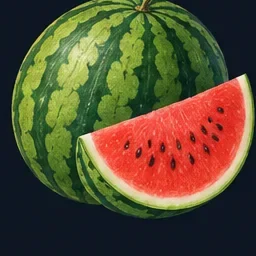
Along the way, you discovered 0 / 36 fruits.
0 countries explored · 0 stories read · 0 / 2 hidden discoveries

Native origin, growing regions and local specialties are different ideas. This is a curated selection, not a complete inventory or production ranking. Original illustrations made with AI assistance.

↑ Back to departure