DISCOVER ·
Fruit · All notes →Cranberry Farmers Flood Their Fields on Purpose — and the Berries Bounce
Every autumn, cranberry growers flood their own fields — on schedule. The fruit floats, the good ones bounce, and almost none of it explains how the plant grows.
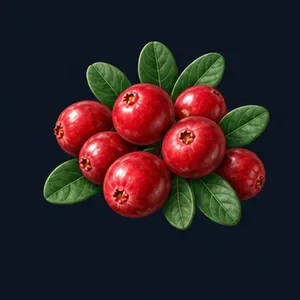
Every autumn in Massachusetts, farmers open the gates and deliberately flood their own fields. The cropland turns into shallow red lakes, churned by machines that everyone calls "egg-beaters." Nobody calls the authorities. It is on the schedule 1 2.
This is the cranberry harvest — and it is also the source of one of the most stubborn beliefs in the produce aisle.
The berry does not live in the water
Here is the twist: the cranberry is not an aquatic plant. It is a low, trailing woody vine that spends the year rooted in well-drained soil — good drainage is essential to its roots during the growing season 1. Flooding is the exception, not the lifestyle: growers mostly use it for winter protection, for harvest, and for a few specialized pest-control floods 1. The rest of the year, a bog looks like a slightly rugged field, not a lake.
So why flood it for harvest? Because the fruit comes to you.
The part where the fruit floats
Cranberries have small pockets of air inside the fruit. Fill a bog, knock the berries loose, and they float to the surface on their own — which is exactly the point. Water reels nicknamed "egg-beaters" stir the fruit off the vine, the berries bob up in a crimson raft, and growers corral them, pump them into trucks, and drain the field again 2.
More than 90% of the Massachusetts crop takes this watery route 2 3.
But here is the second twist: that floating fleet is not headed for the fresh produce section. Water-harvested fruit goes to juice, sauce, and dried cranberries 3. The shiny fresh berries in the supermarket are almost all dry-harvested — picked by machines from dry vines on the roughly 5% of the crop where the fruit must stay firm, unblemished and, above all, dry 3. Even a heavy dew the night before is enough to postpone a fresh-fruit harvest 3.
So the famous images of cranberry lakes? That is the processed side of the crop. The fresh bag in your fridge took the dry road.
And then they bounce
The strangest habit of this industry is also a traditional quality test: good cranberries bounce. Growers grade and screen fresh fruit partly on color and on the ability to bounce — soft or damaged berries simply will not 2.
A New Jersey food-history account published in 2010 tells a story about grower John "Peg Leg" Webb. Unable to carry barrels down from his attic, he tipped them and let the berries bounce down the stairs. The firm berries made it to the bottom; the tale credits this observation with inspiring a bounce-based separator 4. It is a memorable local origin story, not proof that every detail happened exactly that way.
See the red lakes for yourself
If you only remember one thing: the plant prefers dry land, the harvest prefers a flood, and the fruit — helpfully — floats. The rest is plumbing. Our Fruit Journey project stops in North America with the cranberry and the flooded-harvest story, along with the other fruits that grew famous on the same continent.
And next September, when the flood videos start circulating again, you can be the person who says: no, they do not grow in there. They are just passing through.
About the facts in this article
- What is sourced: vine biology and flood uses rest on UMass 1; floating, wet and dry harvesting, and bounce-based grading rest on the growers association 2 3. The Webb stairs story is attributed to a local food-history account 4.
- What is editorial: "the processed side of the crop" drawn from the 90%/5% figures is our synthesis of 2 and 3; the closing framing is ours.
- The stairs story is a local retelling rather than a verified reconstruction of the invention.
Sources
- UMass Amherst — The cranberry (Bog construction & management) Cranberry as a trailing woody vine on well-drained bog soil; flooding confined to winter protection, harvest and specialized pest-control floods; sanding and bog structure.
- Cape Cod Cranberry Growers’ Association — How Cranberries Grow: Fall Air pockets inside the fruit; berries float when bogs are flooded; water reels nicknamed "egg-beaters"; more than 90% wet-harvested; fresh fruit graded and screened on color and ability to bounce.
- Cape Cod Cranberry Growers’ Association — Dry Harvest Dry-harvested fruit sold as fresh fruit; about 5% of the Massachusetts harvest; wet-picked fruit goes to juice, sauce, dried cranberries; vines must be completely dry, dew or frost dampness delays harvest.
- JerseyBites — "Cranberries, the Pine Barrens and John ‘Peg Leg’ Webb" (2010) A 2010 local account of Webb tipping berries out of barrels and down stairs, connecting their bounce to quality sorting. Treated here as a retold origin story.